
Introduction: The ₹2,000 Mistake You Keep Making
Picture this. You dash into a clinic for a ten-minute prescription pickup. Twenty minutes later — thanks to the queue that “only had two people” — you walk back to your car and find a challan slip wedged under the wiper. ₹2,000. Gone. For parking in a spot you didn’t even realize was a no-parking zone.
If you’ve driven in any Indian city for more than a year, you’ve lived some version of this story. Maybe it was a tow truck hauling your bike from outside a metro station, or a society security guard threatening to clamp your tyres because you blocked the visitors’ bay during a 30-second parcel pickup.
Here’s the thing most drivers don’t consider: the majority of parking fines aren’t issued because people want to park illegally. They happen because nobody could reach the car owner in time.
A security guard spots your car blocking a gate. He looks for a phone number on the dashboard — there isn’t one (or the sun has faded it beyond legibility). He waits five minutes. Then ten. Eventually, he calls the traffic police, and by the time you walk out with your prescription, you owe money to the municipality.
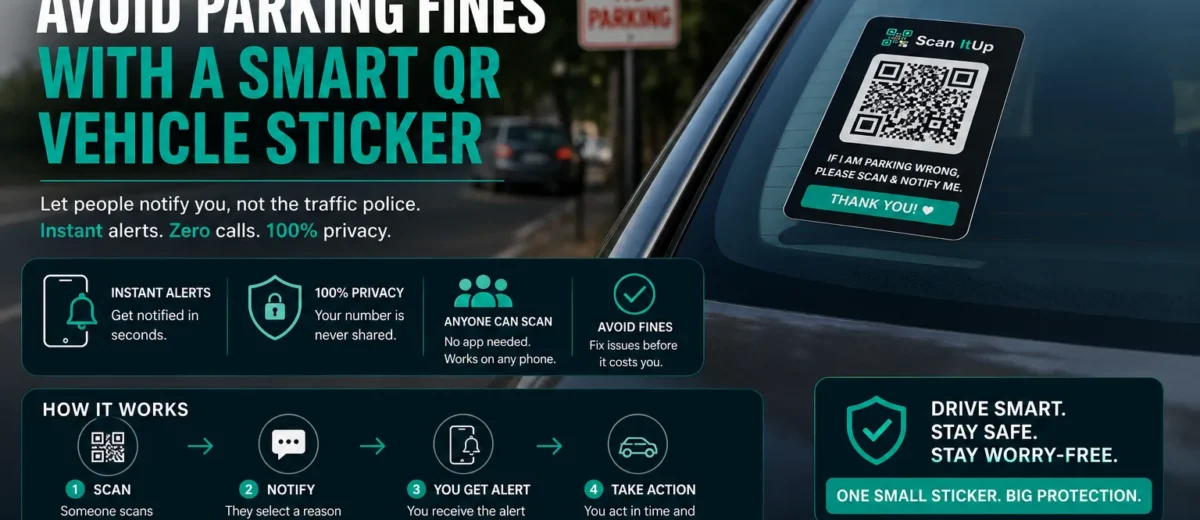
That’s the gap a smart QR vehicle sticker fills. Not with GPS trackers or expensive subscription hardware — but with a simple, scannable tag that lets anyone notify you about your parked vehicle in under 60 seconds. No app download required on the scanner’s end. No personal phone number exposed.
Let’s break down exactly how it works, why it outperforms every other method, and how platforms like Scan It Up are turning a ₹50 sticker into a parking-fine insurance policy.
What Is a Smart QR Vehicle Sticker?
A smart QR vehicle sticker is a durable, weather-resistant label containing a unique QR code that you apply to your car’s windshield, bumper, or rear window. When scanned by any smartphone camera, it opens a secure web page where the scanner can alert you about a parking issue, a headlight left on, a flat tyre, or an emergency — without ever seeing your personal phone number.
Think of it as a digital “contact the owner” system that replaces the handwritten phone-number cards people wedge behind windshield wipers.
Key components of a smart QR vehicle sticker:
- Unique QR code linked to your vehicle profile
- Privacy-protected scan page — your phone number stays hidden
- One-tap alert categories — wrong parking, headlights on, flat tyre, accident
- Instant notifications via WhatsApp, app, and email
- Scan history dashboard with timestamps and locations
Unlike generic QR code generators, purpose-built platforms like Scan It Up pair the QR with a notification engine, privacy layer, and pre-set alert reasons — so the person scanning doesn’t need to type a message or download anything.
Why Parking Fines Are More Than Just a Money Problem
Parking penalties across Indian cities have risen sharply. In metro cities like Delhi, Mumbai, and Bangalore, wrong-parking challans now range from ₹500 to ₹5,000 depending on the zone and repeat-offence history. Towing charges add another ₹1,500 to ₹3,000 on top. And in 2025, several municipal corporations began issuing fines digitally via CCTV and ANPR (Automatic Number Plate Recognition) cameras — meaning you might not even know you’ve been fined until you check your vehicle’s pending challans online.
But financial cost is only part of the story:
- Time lost: Retrieving a towed vehicle can eat 3–5 hours of your day, factoring in locating the impound lot, standing in queues, and completing paperwork.
- Stress and confrontation: Arguments with parking attendants, security guards, or traffic police are draining — and entirely preventable.
- Vehicle damage: Tow trucks aren’t gentle. Scratched bumpers, bent mudguards, and damaged undercarriages are common collateral.
- Insurance complications: Repeated challans in some jurisdictions flag your vehicle record, potentially affecting insurance renewal premiums.
The underlying issue in almost every scenario is communication failure. If the person who noticed the problem could have reached you in two minutes, the fine — and everything that follows — would never have happened.
How a Smart QR Vehicle Sticker Prevents Parking Fines: Step by Step
Here’s the practical workflow, using Scan It Up’s vehicle QR tag as a real example:
Step 1 — Create Your Vehicle Profile (2 Minutes)
Sign up on Scan It Up with email or Google login. Add your vehicle’s nickname (e.g., “White Swift — MH 12 AB 1234”), emergency contact, and blood group. Your unique QR code is generated instantly.
Step 2 — Design and Print Your Sticker
Choose from 29+ professionally designed sticker templates — Neon Night, Frosted Glass, Retro, Minimal, and more. Preview with your actual QR code and vehicle name. Download as a high-resolution PNG or print a sheet with multiple copies.
Step 3 — Apply to Your Vehicle
Stick the QR tag on a visible surface: inside the windshield, on the rear bumper, near the fuel cap, or on a helmet if you ride a two-wheeler. The stickers are UV-resistant and waterproof — built to survive Indian summers, monsoons, and carwash cycles.
Step 4 — Get Alerted Before the Fine Happens
A security guard, fellow driver, or passerby notices your car is blocking a lane. They pull out their phone, scan the QR code (no app needed), and tap “Wrong Parking” from the pre-set alert menu. You receive a WhatsApp notification within seconds — complete with the scanner’s city and timestamp.
You walk out, move your car, and go on with your day. No challan. No tow truck. No confrontation.
Smart QR Sticker vs. Other Parking Fine Prevention Methods
Not sure if a QR sticker is worth it compared to alternatives? Here’s an honest comparison:
| Method | Prevents Fines? | Privacy | Cost | Requires App/Device? | Works for Others to Contact You? |
| Smart QR Vehicle Sticker | ✅ Yes — instant alerts | ✅ Phone number hidden | Free to low-cost | ❌ No app for scanner | ✅ One-tap alert system |
| Dashboard Phone Number Card | ⚠️ Sometimes — if legible | ❌ Number exposed to everyone | Free | ❌ No | ⚠️ Only if they call and you answer |
| GPS Vehicle Tracker | ❌ No — tracks location, not parking issues | ✅ Private | ₹3,000–₹15,000 + subscription | ✅ Yes | ❌ No |
| Parking Timer App | ⚠️ Only for metered spots | ✅ Private | Free to ₹500/year | ✅ Yes | ❌ No |
| Dashcam | ❌ No — records but doesn’t alert | ✅ Private | ₹2,000–₹10,000 | ❌ No | ❌ No |
The QR sticker is the only method that enables two-way communication between a concerned bystander and the vehicle owner — which is exactly the communication gap that causes most preventable parking fines.
5 Real Scenarios Where a QR Sticker Saves You from a Parking Fine
1. The Office Parking Lot Shuffle
You parked in Bay 12 at your office complex. An important client meeting runs long. Meanwhile, the car in Bay 11 needs to leave — and you’re blocking them. With a QR sticker on your windshield, the blocked driver scans your tag, taps “Wrong Parking,” and you get a WhatsApp alert. You excuse yourself for 90 seconds, move the car, and avoid the facilities manager’s angry email that usually ends with “repeated offenders will be fined ₹1,000.”
2. The Hospital Visitor Double-Park
Hospitals have notoriously tight parking. You double-park for a quick emergency-room visit. A QR sticker means the driver you’ve boxed in can notify you the moment they need to leave — instead of calling security, which escalates to a fine or tow.
3. The Apartment Society Visitor Spot
Residential societies are strict about visitor parking. Overstay by 30 minutes, and a penalty notice lands on your windshield (or worse, your tyres get clamped). A QR alert from the guard gives you a timely nudge before the grace period expires.
4. The Metro Station Quick Stop
You drop someone off near a metro station and wait in a no-parking zone “just for a minute.” A traffic warden spots you. With a QR sticker, a friendly passerby — or even the warden — can scan and alert you before writing the official challan.
5. The Market-Area Unknown Restriction
You park on what looks like a perfectly legal side street near a market. Turns out there’s a no-parking restriction between 4 PM and 8 PM — and you missed the faded, half-hidden sign. A local shopkeeper who’s seen cars get towed from that spot scans your tag and tips you off. You move. Fine avoided.
Beyond Parking: Other Ways a Vehicle QR Tag Protects You
The parking-fine angle is compelling, but a Scan It Up vehicle tag does more:
- Headlights-left-on warning: A passerby notices your headlights draining the battery in a parking lot and alerts you instantly.
- Flat tyre notification: Someone spots a deflating tyre and sends you a report before you drive on it and damage the rim.
- Accident emergency response: If you’re in an accident and incapacitated, first responders scan your windshield tag to access your blood group, allergies, and emergency contacts. This is where the QR sticker overlaps with medical emergency QR tags — potentially life-saving information accessible in seconds.
- Minor damage reporting: A delivery truck clips your parked car’s mirror. The truck driver (or a witness) scans the QR and reports the damage with context — giving you evidence and a timestamp you’d otherwise never have.
For people who also want to protect belongings inside the car — laptops, bags, wallets — Scan It Up offers dedicated personal item QR tags and electronics QR tags that work on the same notification platform.
What Makes a Good QR Vehicle Sticker? (Buyer’s Checklist)
Not all QR stickers are equal. If you’re evaluating options, look for these features:
- Privacy-first design — Your phone number should never appear on the scan page. The platform should relay communication, not expose it.
- No-app scanning — The person scanning shouldn’t need to download anything. A standard smartphone camera should be enough.
- Pre-set alert categories — “Wrong Parking,” “Headlights On,” “Flat Tyre,” “Emergency” — so the scanner can report with one tap.
- Instant multi-channel notifications — WhatsApp, email, and in-app alerts ensure you don’t miss the message.
- UV and weather resistance — Indian conditions demand stickers that survive 45°C summers, monsoon rains, and frequent carwashes.
- Scan history and analytics — A log of when, where, and why your tag was scanned helps in parking disputes and insurance claims.
- Multiple vehicle support — Manage your car, bike, and spouse’s scooter from a single dashboard.
Scan It Up checks every box — and your first tag is free, with no credit card required.
How to Set Up Your Smart QR Vehicle Sticker in Under 5 Minutes
If you’ve read this far and want to get started, here’s the quick-start path:
- Visit com/app and sign up (Google login takes 10 seconds).
- Select “Vehicle” as your tag category.
- Fill in details — vehicle nickname, registration number, emergency contact, blood group.
- Pick a sticker design from 29+ options. Preview it with your actual QR and name.
- Download and print — PNG for a print shop, or A4 sheet for home printing.
- Stick it on your windshield or bumper.
That’s it. No subscription. No hardware. No GPS device to install. Your vehicle is now protected by a smart, scannable communication layer — and you’ve significantly reduced your chances of getting an avoidable parking fine.
If you also have pets, consider adding a pet QR tag to their collar — the same scan-and-notify system helps reunite lost pets with their owners. And for anyone travelling frequently, luggage QR tags provide the same peace of mind for checked bags and cabin luggage.
The Bigger Picture: Smart QR Tags as Everyday Infrastructure
We’re at an interesting inflection point. QR codes went from restaurant menus during the pandemic to a genuine utility layer for physical objects. The leap from “scan to view a menu” to “scan to alert a car owner” is small technologically but massive in practical impact.
Parking fines are a symptom of a communication problem. Smart QR vehicle stickers are a communication solution. They cost almost nothing, require zero technical skill, and work anywhere a smartphone camera works — which, in 2026, is essentially everywhere.
The question isn’t whether a QR sticker on your windshield is worth it. The question is how many ₹2,000 challans you’re willing to collect before you spend five minutes setting one up.
Frequently Asked Questions (FAQs)
What is a smart QR vehicle sticker?
A smart QR vehicle sticker is a durable, weather-resistant label with a unique QR code linked to your vehicle profile. When anyone scans it with their phone camera, they can instantly alert you about wrong parking, headlights left on, flat tyres, or emergencies — without your phone number being visible.
How does a QR sticker help avoid parking fines?
It enables instant communication between the person who notices your parking issue and you. Instead of calling traffic police or a tow truck, the scanner taps a pre-set alert reason, and you get a WhatsApp notification within seconds — giving you time to move your vehicle before a fine is issued.
Is my phone number visible when someone scans the QR code?
No. Platforms like Scan It Up use a privacy-first system where your phone number is completely hidden from the scan page. The scanner can contact you through a built-in message form or a relayed WhatsApp button — your real number never appears.
Does the person scanning need to download an app?
No. The QR code opens a standard web page in the phone’s browser. The scanner simply selects an alert reason and taps send. No app download, no account creation, no extra steps.
How much does a smart QR vehicle sticker cost?
Many platforms offer the first QR vehicle tag for free. Scan It Up, for example, lets you create, design, and download your first tag at zero cost with no credit card required. Premium plans are available for users who need additional tags or features.
Can I use one QR sticker for multiple vehicles?
Each vehicle should have its own unique QR sticker linked to its own profile. However, platforms like Scan It Up let you manage multiple vehicle tags from a single account dashboard — so you can monitor your car, bike, and family vehicles in one place.
Will the sticker survive Indian weather — sun, rain, and carwashes?
Yes. Quality vehicle QR stickers are UV-resistant, waterproof, and designed to withstand extreme heat, heavy rain, and regular carwash cycles without fading or peeling.
Can a QR vehicle sticker help in road accidents?
Absolutely. In an accident, first responders or bystanders can scan the sticker to instantly access your blood group, medical conditions, emergency contacts, and allergy information — critical data that speeds up emergency response when every second counts.
