
Table of Contents
- Introduction: The Phone Call That Changed Everything
- Why Dogs Go Missing in India — And Why Traditional Methods Fail
- What Is a QR Pet Tag and How Does It Actually Work?
- Real Stories: Indian Dogs Reunited Through QR Tags
- QR Dog Tags vs Traditional Engraved Tags: A Complete Comparison
- Why Indian Pet Owners Need QR Tags More Than Anyone Else
- How Rescue Organizations Are Using QR Tags to Transform Adoption
- What Makes Scan It Up Different From a Plain QR Sticker
- A Complete Pet Safety Checklist for Indian Dog Parents
- Frequently Asked Questions
Priya was halfway through a client call when her phone buzzed with a WhatsApp message from an unknown number.
“Hi, I found a Golden Retriever near Koregaon Park. I scanned the tag on his collar. Is this your dog?”
Attached was a photo of Simba — her three-year-old retriever — sitting calmly next to a chai stall, about two kilometers from home. The gate had been left open during a grocery delivery. Simba had wandered out. And a stranger with a smartphone had found him, scanned the small QR disc on his collar, and contacted Priya within twenty-two minutes of the escape.
No frantic neighborhood search. No desperate Facebook posts. No sleepless night wondering if her dog was safe. Just a scan, a message, and a reunion before her chai went cold.
This is not a product advertisement. This is what pet recovery looks like in 2026 — and thousands of Indian dog families are living some version of this story right now.
Why Dogs Go Missing in India — And Why Traditional Methods Fail
India is home to an estimated 30–35 million pet dogs, and that number grows every year as adoption culture strengthens in metro and Tier 2 cities alike. But the country’s unique environmental conditions create a perfect storm of escape risks that most Western pet-safety advice simply doesn’t address.
The Uniquely Indian Hazards
Festival season is the biggest culprit. During Diwali alone, animal shelters across Mumbai, Delhi, and Bangalore report a 30–40% spike in intake of panicked, displaced pets. Firecrackers, loud music during Ganesh Chaturthi, Durga Puja dhak drums, and New Year celebrations — these sounds send even well-trained dogs bolting through open doors and jumping compound walls.
Then there are the everyday risks. Open compound gates during deliveries. Construction noise from a neighboring plot. Monsoon thunderstorms. Stray dog confrontations during walks. A cat darting across the road that triggers an off-leash chase.
Why Traditional Recovery Methods Fall Short
When a dog goes missing in an Indian city, most families default to the same desperate playbook:
- WhatsApp group forwards — shared across colony, school parent, and office groups, but buried within hours under unrelated messages
- Handwritten posters — torn down by rain, ignored by most pedestrians, and limited to a tiny geographic radius
- Social media posts — algorithmically deprioritized unless they go viral, which is rare
- Traditional engraved metal tags — faded text, limited to one or two phone numbers, and useless if the number has changed or the finder speaks a different language
Here’s the hard truth: a lost dog’s chances of being reunited with its family drop dramatically after the first 24 hours. Every minute matters. And the traditional toolkit is slow, passive, and dependent on luck.
A lost dog QR tag flips this equation entirely. Instead of hoping the right person sees the right poster, you give every person who encounters your dog the ability to contact you in under sixty seconds — regardless of language, time of day, or whether they have your phone number.
What Is a QR Pet Tag and How Does It Actually Work?
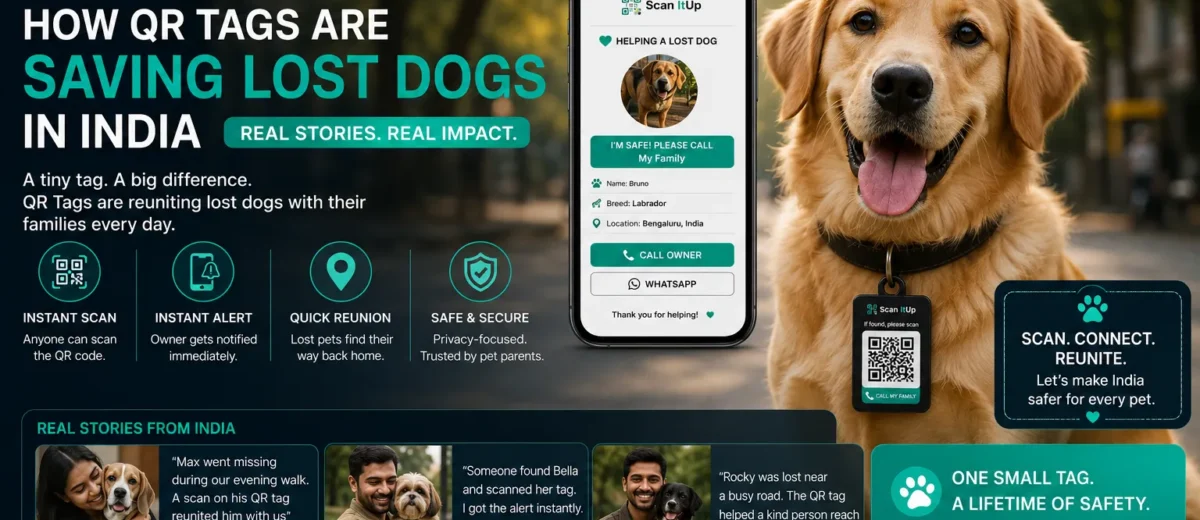
A QR pet tag is a durable, waterproof disc or sticker that attaches to your dog’s collar. It carries a unique QR code that links to a digital pet profile — a living, updatable page containing everything a finder needs to reunite your dog with you.
The Scan-to-Reunite Process
Here’s what happens when someone finds a dog wearing a smart QR collar tag:
Step 1: The finder opens their smartphone camera — any Android or iPhone, no app download required — and points it at the QR code on the collar.
Step 2: A mobile-optimized web page loads instantly, displaying your dog’s name, photo, breed, and a prominent “Help This Pet Get Home” message.
Step 3: The finder taps a button to WhatsApp you, call you through a privacy-protected relay, or send a message through a secure form — all without seeing your actual phone number.
Step 4: You receive an instant notification — via WhatsApp, email, and in-app alert — with the finder’s message, the approximate scan location (city-level), and the time of the scan.
Step 5: You coordinate the reunion directly with the finder through WhatsApp or the messaging relay. Your home address is never displayed on the scan page.
The entire sequence — from scan to owner notification — typically takes under sixty seconds.
What Information Can You Store on a Pet QR Profile?
A comprehensive digital pet profile on platforms like Scan It Up can include:
- Pet’s name, photo, breed, and age — immediate visual confirmation for the finder
- Your phone number(s) and WhatsApp contact — privacy-protected, never displayed raw on the scan page
- Vaccination records and medical conditions — critical if a vet or shelter processes your dog before you arrive
- Allergies and current medications — prevents dangerous drug interactions during emergency vet treatment
- Your veterinarian’s contact details — so any clinic that receives your dog can consult your regular vet
- Custom messages in multiple languages — a line in Hindi, Kannada, Tamil, or Marathi that says “This dog is lost. Please scan and contact my family.”
Unlike a static engraved tag, this information is editable anytime. Changed your phone number? Updated your vet? Moved to a new city? Log in and update the profile — the same physical QR tag on the collar always points to the latest information.
Real Stories: Indian Dogs Reunited Through QR Tags
These recovery accounts illustrate how dog recovery QR codes are working across Indian cities — in situations where traditional methods would have failed.
Simba’s Twenty-Two-Minute Rescue — Pune
The story that opened this article happened in October 2025. Priya Nair, a UX designer living in Koregaon Park, Pune, had created a Scan It Up profile for her Golden Retriever Simba two weeks before the incident — partly on impulse, partly because a friend in her dog-walking group had recommended it.
When Simba wandered through an open gate during a Blinkit delivery, the compound watchman didn’t notice. But a chai stall owner two kilometers away did notice a well-groomed retriever sitting near his cart. He spotted the QR disc on the collar, pulled out his phone, and scanned it.
“I didn’t even know what it was at first,” he told Priya later. “But it said SCAN ME in Hindi and English. So I scanned. Your photo came up, the dog’s photo came up, and there was a big green WhatsApp button. I just pressed it.”
Priya’s phone buzzed twenty-two minutes after Simba had left the gate. She was reunited within the hour.
Why it worked: The QR tag carried a bilingual “SCAN ME” instruction. The chai stall owner — who had a basic Android phone and spoke primarily Hindi — could contact Priya without knowing English, without knowing her number, and without downloading any app. The WhatsApp-native contact system removed every friction point.
Kali Survives Two Days Missing — Lucknow
Ritu Sharma’s indie rescue dog Kali disappeared during a late-night thunderstorm in August 2025. The latch on their terrace door had broken, and Kali — terrified of thunder since her street-dog days — bolted into the rain.
Two days of searching followed. WhatsApp forwards. Facebook posts. Handwritten posters in the colony. Nothing.
Then, on the morning of day three, Ritu’s phone rang. A security guard at a commercial complex three kilometres away had found Kali hiding under a stairwell. He’d seen the QR tag on her collar, asked a young office worker to scan it for him, and the scan page loaded Ritu’s WhatsApp contact instantly.
“When I got the call, I cried for ten minutes,” Ritu says. “I kept thinking — two days. Two full days of not knowing if she was alive or hurt. And this guard, who had no idea who I was, who had never heard of QR pet tags before — he brought her back to me because scanning was that easy.”
Why it worked: Kali’s QR tag survived two days of monsoon rain — the waterproof disc remained fully scannable. The security guard couldn’t scan the code himself, but the tag’s visual design prompted him to ask for help. The scan page worked on the office worker’s phone without any app installation or account creation.
Mango Crosses a Language Barrier — Bangalore
Rajan Mehta’s Golden Retriever Mango wandered out of their Whitefield apartment complex during a power cut in November 2025. The security camera system was offline. By the time Rajan noticed, Mango was gone.
The person who found Mango — a construction worker from Karnataka — spoke only Kannada and used a basic smartphone. But Rajan had done something clever when setting up Mango’s QR profile: he’d added a custom message in Kannada.
“ಈ ನಾಯಿ ಕಳೆದುಹೋಗಿದೆ. ದಯವಿಟ್ಟು ಈ ನಂಬರ್ಗೆ ಕರೆ ಮಾಡಿ.”
(“This dog is lost. Please call this number.”)
The worker scanned, read the Kannada message, and called. Mango was home within the hour.
“I had no idea you could add regional language messages,” Rajan says. “That one feature — just one line in Kannada — is the reason I got my dog back. An engraved tag in English would have been completely useless.”
Why it worked: The multilingual custom message feature turned a language barrier into a non-issue. The QR code itself is language-agnostic — it’s just a pattern that any camera reads. The scan page content, including the Kannada message, did the rest.
Buddy Comes Home Before Dinner — Colony Recovery
This story comes directly from the Scan It Up testimonials page:
“My Golden Retriever Buddy escaped our gate when the courier rang. He was found 3 hours later by a family in the next colony. They scanned his Scan It Up tag and messaged me through the app. He was home for dinner — no flyers needed, no panic posting on groups.”
Three hours. One scan. No flyers. No Facebook posts that get two reactions and zero leads.
QR Dog Tags vs Traditional Engraved Tags: A Complete Comparison
If you’re weighing whether to upgrade from a traditional engraved tag to a smart dog tag with QR technology, this comparison covers every dimension that matters for Indian pet owners:
| Feature | Traditional Engraved Tag | QR Pet Tag (Scan It Up) |
| Contact information displayed | 1–2 phone numbers, physically etched | Unlimited contacts — phone, WhatsApp, email, vet, emergency |
| Updatable without replacement | ❌ Must buy a new tag | ✅ Edit profile anytime — same physical tag |
| Privacy protection | ❌ Number visible to every passerby | ✅ Number hidden behind privacy-protected relay |
| Multilingual support | ❌ One language only | ✅ Custom messages in Hindi, Kannada, Tamil, Marathi, or any language |
| Medical info for vets | ❌ No space on tag | ✅ Vaccinations, allergies, medications, vet contact |
| Pet photo for confirmation | ❌ Not possible | ✅ Photo, breed, and name displayed on scan page |
| Works in rain and mud | ⚠️ Etching may corrode over time | ✅ Waterproof, UV-resistant QR disc |
| Finder needs an app? | N/A | ❌ No app — native camera scan |
| WhatsApp contact option | ❌ Manual number entry | ✅ One-tap WhatsApp with pre-filled message |
| Owner notification on scan | ❌ No way to know if someone read the tag | ✅ Instant alert with scan location and time |
| Works if phone number changes | ❌ Tag becomes useless | ✅ Update number online — tag keeps working |
| Cost | ₹100–500 per tag | ✅ First tag free on Scan It Up |
The difference isn’t incremental — it’s generational. An engraved tag is a static label. A QR tag is a living digital connection between your dog and your family.
Why Indian Pet Owners Need QR Tags More Than Anyone Else
India presents a constellation of challenges for lost pet recovery that make QR pet tags not just convenient, but genuinely essential.
1. Language Diversity Makes Engraved Tags Ineffective
India has 22 officially recognized languages and hundreds of regional dialects. Your dog might escape in Pune and be found by someone who reads only Marathi. Or your family relocates from Chennai to Gurgaon, but the engraved tag still says your Chennai phone number in Tamil script. A QR pet tag with multilingual messaging and updatable contacts solves this completely.
2. WhatsApp Is India’s Communication Infrastructure
Over 500 million Indians use WhatsApp daily. It’s not just a messaging app — it’s how India communicates. A pet QR tag with native WhatsApp integration means the finder contacts you on the platform they already use hourly. No friction. No learning curve. One tap.
3. Festival Seasons Create Predictable Spikes in Lost Pets
Diwali, New Year, Ganesh Chaturthi, Durga Puja, Holi — every major Indian festival creates noise, crowds, and chaos that frighten pets into running. These aren’t random risks. They’re calendar events you can prepare for. Getting a QR tag before festival season is the single most effective preparation step a dog parent can take.
4. High Smartphone Penetration Makes QR Tags Universally Scannable
India has over 750 million smartphone users. Even in Tier 2 and Tier 3 cities, the person who finds your dog almost certainly carries a phone that can scan a QR code using its native camera. No app needed. No special hardware. The infrastructure for pet identification QR is already in every pocket.
5. Urban Density Means Dogs Travel Far, Fast
In a dense city like Mumbai or Delhi, a scared dog can cover several kilometres in under an hour — crossing colony boundaries, navigating traffic, and ending up in an area where nobody recognizes them. The faster a finder can contact you, the smaller the danger window. A QR tag compresses that contact time from days (posters) or hours (social media) to seconds.
How Rescue Organizations Are Using QR Tags to Transform Adoption
Animal rescue groups across India are beginning to integrate QR tags into their adoption protocols — and the impact on reunion rates is significant.
The Shelter’s Perspective
When a rescue organization hands over an adopted dog to a new family, their biggest fear is that the dog escapes during the adjustment period. New homes, unfamiliar scents, different sounds — the first two weeks are the highest-risk window for escape.
Progressive shelters now attach a QR collar tag before handover, pre-loaded with the new owner’s contact details, the shelter’s backup contact, and the dog’s medical history. If the dog escapes during the adjustment period, any finder can scan the collar and reach both the new owner and the shelter — creating a safety net that traditional methods can’t match.
Why Rescue Organizations Prefer QR Over Engraved Tags
- Profiles transfer instantly — when a dog is adopted, the tag profile switches from the shelter’s contact to the new owner’s contact in minutes
- Medical records travel with the dog — vaccination dates, spaying status, any known conditions are on the scan page, accessible to any vet who receives the dog
- No recurring cost per tag — platforms like Scan It Up offer the first tag free, making it feasible for underfunded rescue operations
- Reduces “lost again” heartbreak — the number-one morale killer for shelter volunteers is learning that an adopted dog escaped and was never found
What Makes Scan It Up Different From a Plain QR Sticker
Not every QR code on a collar is equal. You could technically print a QR code that links to a Google Doc with your phone number. But that’s like calling a Post-it note on your car a “vehicle safety system.”
Scan It Up is a purpose-built smart digital identification and recovery platform powered by QR technology. Here’s what sets it apart from generic QR stickers or basic tagging services:
Privacy-First Architecture
Your phone number is never displayed on the scan page. Finders contact you through a privacy-protected relay — WhatsApp, call, or secure message form — without seeing your actual number. This matters enormously in India, where phone number exposure leads to spam calls, telemarketing, and worse.
Instant Owner Notification
The moment someone scans your pet’s QR tag, you receive a real-time alert — via app notification, email, and WhatsApp — with the scan’s city, timestamp, and any message the finder sends. You know your dog has been found before you’ve even started panicking.
Waterproof, Durable Collar Discs
Scan It Up’s pet QR tags are IP65-rated — waterproof, mud-resistant, UV-resistant, and designed to survive baths, monsoon rain, rough play, and the general chaos of being on a dog collar in India.
29+ Professional Sticker Designs
A generic black-and-white QR code looks like a tech experiment. Scan It Up offers 29+ professionally designed templates — including designs with clear multilingual “SCAN ME” instructions that make the tag immediately recognizable and actionable for finders.
Part of a Connected Safety Ecosystem
Your pet tag exists within a broader ecosystem that includes vehicle tags, medical emergency QR IDs, luggage and bag tags, personal item tags, and kids and senior safety tags. One account, one dashboard — protecting everything you care about.
Free to Start
Your first pet QR tag on Scan It Up is completely free. Create your profile, design your sticker, download and print — at zero cost. No credit card. No trial period. No catch.
A Complete Pet Safety Checklist for Indian Dog Parents
A QR tag is the cornerstone — but comprehensive pet safety in India requires a layered approach. Here’s the practical checklist every responsible dog parent should follow:
Identification Layer
- ☐ Create a QR pet profile on Scan It Up with current photos, contacts, and medical information
- ☐ Attach the QR tag securely to a well-fitting collar — check collar fit monthly as your dog grows or gains weight
- ☐ Get your dog microchipped at your vet — QR tags and microchips are complementary, not competing, systems
- ☐ Add a custom message in your local language so finders from any background can understand the tag
Preparedness Layer
- ☐ Update your QR profile before every trip — add the destination vet’s number and a local emergency contact
- ☐ Test the QR scan yourself every few months — scan the tag with your own phone to confirm the link works and information is current
- ☐ Share your pet’s QR profile link proactively with your colony WhatsApp group, dog walker, pet sitter, and vet
Prevention Layer
- ☐ Secure all exit points before festival seasons — gates, doors, balconies, terrace access
- ☐ Use a double-leash system during walks in high-traffic areas
- ☐ Keep recent, high-quality photos of your dog on your phone — if you do need to make posters, you’ll have them ready
- ☐ Consider anxiety medication (consult your vet) for dogs with severe noise phobia during Diwali
Emergency Layer
- ☐ Save your local animal control number and nearest 24-hour vet clinic contact
- ☐ Join your city’s pet recovery WhatsApp group or Facebook community as a backup social channel
- ☐ Keep your vet’s number on the QR profile so any shelter or clinic that receives your dog can coordinate treatment
Frequently Asked Questions
What is a QR dog tag and how does it help find lost dogs?
A QR dog tag is a small, waterproof disc or sticker attached to your dog’s collar that contains a scannable QR code. When someone finds your lost dog, they scan the code using their smartphone camera — no app needed — and instantly see your dog’s name, photo, and contact options. They can WhatsApp you, call you through a privacy-protected relay, or send a message through a secure form. You receive an instant notification with the scan location and the finder’s message, dramatically reducing reunion time from days to minutes.
Are QR pet tags better than traditional engraved dog tags?
Yes, for several important reasons. Engraved tags display only one or two phone numbers, can’t be updated if your number changes, offer no privacy protection, and become illegible over time due to wear. QR pet tags link to a living digital profile that stores unlimited contacts, medical information, pet photos, multilingual messages, and vet details — all updatable without replacing the physical tag. They also protect your privacy by never displaying your actual phone number to strangers.
Do I need to download an app to scan a pet QR tag?
No. Modern smartphones — both Android and iPhone — scan QR codes directly through the built-in camera app. The finder simply points their camera at the tag, taps the notification that appears, and lands on the pet’s profile page in their mobile browser. This zero-friction design is essential in India, where the finder could be anyone — a shopkeeper, a security guard, a schoolchild — and requiring an app download would create a barrier to reunification.
How is a QR pet tag different from a GPS tracker collar?
A GPS tracker is an electronic device that requires charging, cellular connectivity, and a monthly subscription — and it only tells you where your dog is. A QR pet tag is passive technology (no battery, no subscription) that empowers anyone who finds your dog to contact you directly. GPS trackers help you find your dog. QR tags help other people return your dog to you. Many pet safety experts recommend using both for complete coverage. Read our detailed comparison of QR pet tags vs GPS trackers.
Can a QR pet tag survive rain, baths, and rough play?
Yes. Quality pet QR tags from platforms like Scan It Up are IP65-rated — waterproof, mud-resistant, and UV-resistant. They’re specifically designed for the realities of being on a dog collar in India, including monsoon rain, post-walk baths, muddy park sessions, and the general roughhousing that dogs subject their collars to daily. The QR code remains scannable even after extended outdoor exposure.
What information should I include in my dog’s QR tag profile?
Include your dog’s name and a clear, recent photo (for visual confirmation), two or more contact phone numbers, a WhatsApp number, your veterinarian’s emergency contact, any allergies or medications, vaccination status, and your general area or neighbourhood. If you live in a multilingual city, add a custom message in the local language asking finders to scan and call. The more information you include, the faster and safer the reunion process.
Is Scan It Up free, and does it work across all Indian cities?
Scan It Up’s first QR pet tag is completely free — you can create your account, build your pet’s profile, design a sticker from 29+ templates, and download it for printing at zero cost. The digital profile system works anywhere in India (and globally) — the QR code links to a web page, so as long as the finder has internet access on their smartphone, they can reach you regardless of city, state, or country.
How do QR pet tags protect my privacy compared to writing my number on a collar?
When you engrave or write your phone number on a dog tag, it’s visible to every person who walks past your dog — including spam callers, telemarketers, and data harvesters. A QR pet tag on Scan It Up uses a privacy-protected relay system: the finder sees a contact page with WhatsApp, call, and message buttons, but your actual phone number remains completely hidden unless you explicitly choose to display it. Communication flows through a secure intermediary, keeping your personal information private.
Your Dog Deserves a Path Home
Every story in this article shares one thing in common: a small, inexpensive tag on a collar gave a stranger the tools to do the right thing — quickly, easily, and without friction.
Lost dog QR tags aren’t complicated technology. They aren’t expensive. They don’t require charging, subscriptions, or technical knowledge. They just need to be on your dog’s collar before the moment arrives when you wish they were.
That moment might be a delivery driver leaving the gate open. A thunderstorm on a July night. A firecracker on Diwali evening. You can’t predict the moment. But you can prepare for it.
Create your pet’s free QR tag on Scan It Up →
It takes three minutes to set up. It costs nothing. And it could mean everything the next time your dog goes missing.2
Published by Scan It Up | Smart QR Pet Identification for Indian Pet Families
Category: Pets & Animals | Scan It Up Blog
