
Every Parent’s Worst Phone Call – and How to Prevent It
There’s a particular silence that falls over a parent when their phone rings during a school field trip. For a split second, the world holds still. Is everything fine? Did something happen?
For Meera Nair, a mother of two in Bengaluru, that phone call came on a Tuesday morning. Her seven-year-old, Arjun, had wandered away from his school group at a science museum. It took the teacher forty-five minutes and three headcounts to confirm he was missing. It took another twenty minutes to find him sitting next to a dinosaur replica on a different floor, completely unaware that anyone was looking for him.
Arjun was fine. But those sixty-five minutes changed how Meera thought about school trip safety forever.
“I kept thinking, what if nobody had noticed? What if it wasn’t a museum, but a crowded marketplace?” she told us. “My son doesn’t know my phone number by heart. He can barely say our address correctly.”
Meera’s experience isn’t unusual. Across the country and around the world, schools take children on field trips to zoos, museums, historical sites, parks, and fairs. These outings are enriching and essential. But they also introduce a challenge that terrifies every parent and teacher alike: what happens if a child gets separated from the group?
The answer used to involve handwritten ID cards tucked into backpacks, masking-tape labels on shirts, or simply hoping for the best. Today, a smarter solution exists, and it fits on a child’s wrist.
QR code safety tags are changing how schools protect children during outings, offering instant contact access, real-time parent alerts, and medical information at the scan of a phone.
What Are QR Code Safety Tags for Kids?
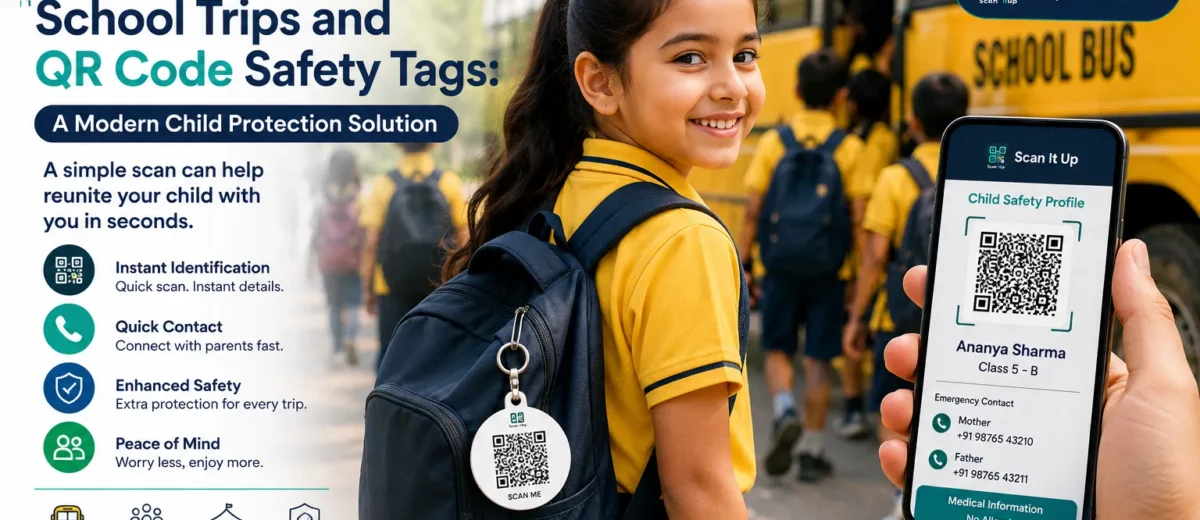
A QR code safety tag is a wearable identification tag, usually a wristband, lanyard, or sticker, embedded with a unique QR code. When scanned by any smartphone camera (no app required), it displays the child’s emergency contact details, a personalised help message, and, optionally, critical medical information like allergies or blood type.
Unlike traditional paper ID tags that display a child’s name and school in plain view, QR-based safety tags keep personal information private until actively scanned. This is an important distinction. A name badge visible to everyone in a crowd creates its own set of risks. A QR code shares nothing until someone makes the deliberate choice to help.
In short: QR safety tags give children a voice when they can’t speak for themselves, and they give parents a direct line of communication when it matters most.
Why Traditional School Trip Safety Methods Fall Short
Let’s be honest about what most schools still rely on:
| Method | What It Does | Where It Fails |
| Paper name tags | Displays child’s name and school | Falls off, gets wet, visible to strangers |
| Matching T-shirts | Helps teachers spot the group visually | Doesn’t help once a child is separated |
| Buddy system | Pairs children together | Kids forget, get distracted, split up |
| Teacher headcounts | Manual roll call at intervals | Time-consuming; gaps between counts |
| Written emergency cards | Parent number tucked in pocket | Children rarely retrieve them; finders can’t access them easily |
| Verbal instructions | “Remember this number” / “Stay with your group” | Young children forget under stress |
None of these methods are bad. Many are necessary. But they all share the same limitation: they depend on either the child or the teacher doing something right, at exactly the right moment, under pressure.
A QR code safety tag removes that dependency. The child doesn’t need to remember a number, find a card, or even speak. A kind stranger, a museum staff member, or a police officer simply scans the wristband, and the parent is alerted within seconds.
How QR Code Safety Tags Work on a School Trip
Here’s how the process unfolds, step by step:
Step 1: Parents or School Create the Safety Profile
Before the trip, a parent (or the school administration) sets up a digital safety profile. This includes the child’s name, a recent photograph, emergency contact numbers for parents and the class teacher, medical information (allergies, conditions, medications), and a personalised help message, something like “Hi, I’m lost. Please scan my wristband and contact my mummy.”
Platforms like Scan It Up make this setup process simple enough to complete in under five minutes.
Step 2: Each Child Receives a Unique QR Wristband
Every child gets a wristband or lanyard with their own unique QR code. The wristband is waterproof, comfortable, and designed to be worn all day without irritation. For younger children, colourful and cartoon-themed designs help make wearing the band feel fun, not clinical.
Step 3: If a Child Gets Separated, Anyone Can Scan the Tag
This is where the real value kicks in. A museum attendant, a vendor, a fellow parent, or any passerby with a smartphone can scan the QR code using their default camera. No app download needed. No login required.
The scan page opens immediately with the child’s photo, the emergency help message, and clear buttons to call or message the parent.
Step 4: Parents and Teachers Are Alerted Instantly
The moment someone scans the tag, the parent receives a real-time notification, via WhatsApp and email, along with the approximate location of the scan. If multiple emergency contacts are listed, all of them are notified simultaneously. No single point of failure. No waiting. No guesswork.
Step 5: Reunion Is Coordinated Directly
The finder and the family connect through the platform. The child is returned. The crisis is resolved, often within minutes, and without PA announcements, police involvement, or panic spreading through the group.
Real Scenarios Where QR Safety Tags Make the Difference
The Museum Wanderer
A class of thirty second-graders visits a natural history museum. One child, fascinated by the marine exhibit, drifts away. Fifteen minutes later, a museum volunteer spots the child alone and scans the wristband. The teacher gets an alert and meets the child at the information desk within six minutes.
The Amusement Park Crowd
India’s biggest fairs and amusement parks draw millions. In the sensory overload, even attentive children get disoriented. A QR wristband means any park employee, food vendor, or police officer can reunite the child with their family, without loudspeaker announcements that may cause wider panic.
The Child with a Severe Allergy
During a school picnic, a child with a peanut allergy accidentally eats something they shouldn’t. Their wristband’s QR code doesn’t just carry contact details, it also displays the child’s allergy information and blood type, giving first responders the critical medical context they need before the parent even arrives.
The Pilgrimage or Religious Gathering
Crowded events like Kumbh Mela or busy temple visits create high-risk scenarios for child separation. A QR wristband on every child in the group provides a decentralised safety net, every person in the crowd becomes a potential helper.
Privacy and Security: Addressing the Elephant in the Room
One of the most common concerns parents raise about QR safety tags is privacy: “Isn’t it risky to put my child’s information on a scannable code?”
It’s a valid question, and the answer depends entirely on how the system is designed.
Well-built platforms address this in several important ways:
- Information is not stored in the QR code itself. The code simply links to a secure, hosted page. The data lives on encrypted servers, not embedded in the image.
- Privacy mode hides your phone number. On platforms like Scan It Up, parents can enable privacy mode, which hides their direct phone number from the scan page. Finders can only contact them through a secure message form.
- No app required for the finder. This eliminates the risk of third-party app permissions or data harvesting on the helper’s end.
- Parents control what’s visible. You choose exactly what information appears: name, photo, medical info, or just a “Please call this number” message. Nothing is shared without your consent.
The bottom line: a QR code safety tag is significantly more private than a visible name badge and more secure than a handwritten card with your phone number on it.
Beyond School Trips: Where Else Do QR Safety Tags Protect Children?
School excursions are the most obvious use case, but QR safety tags work just as well in everyday situations where children are at risk of separation:
- Shopping malls and supermarkets :— A child wanders off in a busy store. A staff member scans the wristband and contacts the parent.
- Family holidays and airports :— Luggage QR tags protect your bags, but the same technology on a child’s wrist protects what truly matters.
- Summer camps and sports events :— Camp counsellors can manage large groups with individual QR identification for every child.
- Playgrounds and public parks:— Younger children playing in open spaces are vulnerable to wandering off. A wristband gives nearby adults the means to help.
- Festivals, concerts, and community events :— Any large gathering where children are present and supervision ratios are stretched thin.
For families with elderly members who have cognitive conditions like Alzheimer’s or dementia, Scan It Up’s Kids & Senior safety tags serve the same function, keeping vulnerable family members connected to their caregivers through a simple, dignified wristband.
What to Look for in a QR Code Safety Tag Platform
Not all QR solutions are created equal. When choosing a platform for your school or family, look for these essentials:
- No app required for the finder. If the Good Samaritan needs to download an app, you’ve lost critical minutes.
- Instant real-time notifications. The parent should be alerted the moment the code is scanned, not hours later via email.
- Multiple emergency contacts. The best systems notify several family members simultaneously.
- Medical info support. For children with allergies, chronic conditions, or specific medications, this feature is non-negotiable. Medical emergency QR tags should integrate seamlessly.
- Privacy controls. The parent must control what the finder sees.
- Durable, child-friendly design. Waterproof, comfortable, and appealing to kids.
- Free or affordable setup. Child safety shouldn’t be gated behind expensive subscriptions.
Scan It Up checks every one of these boxes, with a free-forever first tag, 29+ sticker designs, WhatsApp integration, and a privacy mode that puts parents firmly in control.
How Schools Can Implement QR Safety Tags for Every Trip
If you’re a school administrator or teacher, here’s a practical rollout plan:
- Choose your platform. Create a school account on a QR safety tag platform. Look for group management features that let you manage all students from a single dashboard.
- Collect emergency details. Use your existing permission slip process to gather parent contacts, medical information, and photograph consent.
- Create profiles in bulk. Set up safety profiles for every student attending the trip. Five minutes per child adds up, do this a week before, not the morning of.
- Distribute wristbands on trip day. Assign each child their wristband during attendance. Colour-code by group or class if needed.
- Brief the chaperones. Ensure every adult on the trip understands that if they find a separated child, they scan the wristband first.
- Collect and store wristbands after the trip. Reusable wristbands can be stored for the next excursion.
This isn’t futuristic technology. It’s available right now. And for a school that values student safety beyond the basics, it’s a meaningful step forward.
The Bigger Picture: Technology That Puts Families First
QR code safety tags aren’t a replacement for supervision, headcounts, or good planning. They are a failsafe, a final layer of protection that works precisely when everything else has already failed.
Because the truth is, children wander. It’s what they do. They get curious, distracted, excited, overwhelmed. No amount of briefing or buddy-pairing eliminates that reality entirely. What you can do is ensure that when it happens, when a child slips away from the group for three minutes or thirty, there’s a fast, reliable, human-friendly way to bring them back.
That’s what platforms like Scan It Up deliver. Not GPS tracking. Not surveillance. Just a simple, respectful bridge between a lost child and their family, powered by a technology that nearly every adult on the planet already carries in their pocket.
Your child’s first tag is free. Setup takes five minutes. And the peace of mind? That lasts a whole lot longer.
Create your child’s free safety tag on Scan It Up →
FAQs
What is a QR code safety tag for school trips?
A QR code safety tag is a wearable wristband, lanyard, or sticker with a unique QR code that stores a child’s emergency contact details, medical information, and a help message. When scanned with any smartphone, it instantly connects a lost child with their parent or teacher — without any app download.
How do QR safety wristbands work when a child is lost?
When a child gets separated from their school group, any nearby adult can scan the QR code on the child’s wristband using their smartphone camera. A secure page opens with emergency contact details and a call or message button. The parent receives an instant notification via WhatsApp and email, along with the scan location.
Are QR code safety tags safe for children’s privacy?
Yes, when designed properly. The QR code itself does not contain personal data — it links to a secure, hosted page. Parents control exactly what information is visible. Platforms like Scan It Up also offer a privacy mode that hides the parent’s phone number, allowing finders to contact them only through a secure message form.
Do finders need to download an app to scan the safety tag?
No. A well-designed QR safety tag works with any smartphone’s built-in camera. No app download, no login, and no account creation is required. This ensures that any Good Samaritan can help immediately, without delays.
Can QR safety tags store a child’s medical information?
Yes. Most QR safety tag platforms allow parents to include critical medical details such as allergies, blood type, chronic conditions, and current medications. This information is accessible to first responders and can be lifesaving in an emergency.
How much do QR code safety tags cost for schools?
Many platforms offer a free first tag and affordable plans for bulk use. Scan It Up, for instance, provides the first QR safety tag at no cost, with no credit card required. Schools can create multiple tags for each student and print them using A4 sticker sheets — making large-scale deployment both practical and budget-friendly.
Can QR safety tags be reused for multiple school trips?
Yes. Since the QR code links to a digital profile (not a static printout), the information can be updated anytime. The same wristband or sticker can be reused across multiple trips, events, and school years — parents simply update the contact details or medical info in their dashboard.
Are QR code safety tags better than traditional ID cards for school trips?
QR code safety tags offer several advantages over traditional ID cards. They keep personal information private until scanned, they provide instant parent alerts upon scanning, they can include medical data, and they don’t require the child to remember anything. Traditional IDs are still useful as a backup, but QR tags provide a faster, more secure, and more comprehensive child protection solution.
