
It only takes one crowded school gate for panic to begin.
A parent arrives two minutes late. A child has already moved with another pickup group. The class teacher is handling three calls. The security guard recognizes the child’s face but not the contact number. Everyone is trying to help, but nobody has instant context.
That gap between “good intentions” and “fast action” is where safety systems either succeed or fail.
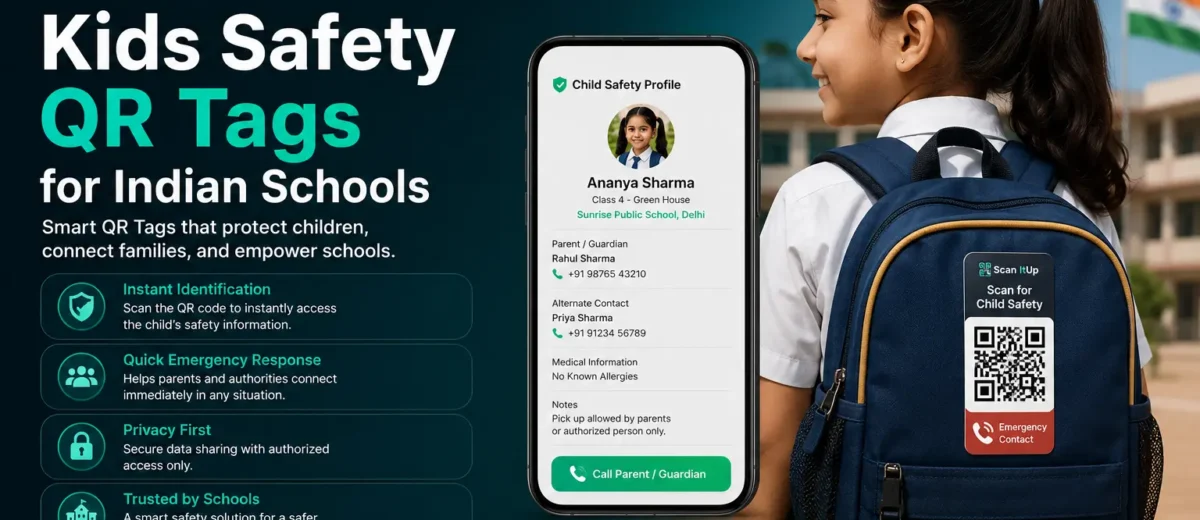
A kids’ safety QR tag closes that gap. With one scan, a verified helper can reach the right family contact and access essential emergency context without the child needing a phone. For Indian schools balancing scale, crowd pressure, and parent expectations, that is a practical safety upgrade, not a tech gimmick.
Scan It Up fits this use case clearly: a smart digital identification and recovery platform powered by QR technology.
Quick Answer: How Do QR Tags Protect Children in Schools?
A child safety QR tag is a scannable ID (wristband, card, or lanyard) linked to a child’s emergency profile.
In urgent moments, it helps by:
- giving verified contact pathways to parents/guardians
- surfacing critical medical details (if enabled)
- reducing response time during separation, confusion, or medical events
- supporting teachers and staff with a structured reunification flow
Why Indian Schools Need Better Child-Safety Infrastructure
India’s school system operates at massive scale. According to a PIB release summarizing Economic Survey 2024-25 and UDISE+ 2023-24, school education serves 24.8 crore students across 14.72 lakh schools with 98 lakh teachers. That scale alone creates operational safety complexity.
The same source also highlights two trends that matter for QR safety adoption:
- schools with computers rose from 38.5% (2019-20) to 57.2% (2023-24)
- schools with internet rose from 22.3% to 53.9% in the same period
In short, digital readiness is improving, and schools now have a stronger base to adopt lightweight safety tools.
At the policy level, school safety is not optional framing anymore. Government documents tied to MoE/NDMA school safety guidance emphasize:
- formal school safety processes
- periodic safety audits
- preparedness and response planning
- child-focused risk reduction
A Lok Sabha response by the Ministry of Home Affairs also shows the seriousness of child-protection workflows: the annex reports large annual missing-children caseloads, with 77,535 missing and 76,827 traced in 2021 (all-India total), alongside official mechanisms such as Child Helpline 1098 and TrackChild.
That context makes one thing clear: schools need systems that improve speed, accuracy, and accountability in the first minutes of an incident.
What Exactly Is a School Child Safety QR Tag?
A school child safety QR tag is a physical identifier linked to a secure digital profile.
It is not the same as attendance QR or fee QR.
AEO-friendly definition
A child safety QR tag is an emergency identification tool that lets responders, teachers, or verified helpers scan and contact guardians quickly while viewing only the safety data required for immediate action.
What it usually includes
- child name and class details
- emergency contact chain
- allergy/medical information (optional but recommended for risk cases)
- child-specific assistance note (“Please contact my mother first”)
- controlled visibility settings for privacy
Where QR Tags Help Most in Real School Life
1. Dispersal-time confusion
When pickup zones are crowded, tags reduce reliance on memory and paper lists. One scan can route communication to the right contact faster than manual escalation.
2. Field trips and inter-school events
Trips to museums, stadiums, science fairs, and religious sites increase movement risk. QR tags help staff reunify students quickly without public sharing of family numbers.
3. Medical urgency at school
If a child has asthma, food allergy, epilepsy, or diabetes, staff need immediate clarity. A configured profile can reduce treatment delay and avoid avoidable medication mistakes.
4. School transport transition points
Bus boarding, drop-off clustering, and route handovers are high-friction moments. QR tags give a backup identity-and-contact layer when voice communication is noisy or delayed.
5. Language and communication barriers
India’s multilingual environment is real. Safety pages that present clear, simple information improve helper confidence and reduce hesitation.
How Scan It Up Approaches Kids’ Safety
Scan It Up’s kids-and-senior safety use case is built around a practical idea: the child should not need a phone to be reachable in a crisis.
From the product flow:
- setup takes a few minutes
- tags can be worn on wrist/lanyard
- alerts can reach family contacts quickly
- profiles can include medical context
- updates can be made without replacing the physical tag
Scan It Up also emphasizes:
- no-smartphone dependency for the child
- multi-contact family alert flow
- multilingual scan experience
- privacy-aware contact relay model
Natural CTA moment for schools and parents:
If your school already issues ID cards, adding a safety QR layer is a low-friction next step. Start with a small class pilot during events season, then scale.
QR Tags vs Traditional Child-Safety Methods
| Method | Speed in Incident | Medical Context | Privacy | Update Flexibility | School Fit |
|---|---|---|---|---|---|
| Paper emergency card | Slow (manual lookup) | Medium | Low to medium | Low | Basic |
| Printed phone-number badge | Medium | Low | Low (number exposed) | Low | Common but risky |
| GPS smartwatch | High | Medium | Medium | Medium | Costly at scale |
| Safety QR tag | High (scan-first) | High (if configured) | High (relay model) | High | Strong for schools |
Implementation Blueprint for Indian Schools
Phase 1: Pilot
- Choose one grade or one bus route cluster.
- Map high-risk moments: gate dispersal, sports day, off-campus trips.
- Run a 30-day pilot with consented parent onboarding.
Phase 2: Safety profile standards
Define what is mandatory vs optional.
- Mandatory: name, class, primary guardian, secondary guardian
- Recommended for at-risk children: allergies, chronic conditions, emergency instructions
- Optional: home address (only if policy allows and family consents)
Phase 3: Staff training
Train class teachers, gate staff, transport staff, and nurse room teams on:
- when to scan
- how to validate context
- how to escalate to school admin and parent
- incident logging discipline
Phase 4: Drill integration
Blend QR scans into existing mock drills and school safety routines.
MoE/NDMA-linked guidance already emphasizes preparedness, audits, and safety planning; QR workflows should support those processes, not sit outside them.
Phase 5: Governance and review
- quarterly process audits
- incident review meetings
- parental feedback loop
- data minimization checks
Privacy and Security: The Non-Negotiable Layer
Any child-safety technology can fail if privacy design is weak.
A useful principle: minimum data, maximum response clarity.
Practical safety controls schools should insist on
- no unnecessary personal data on public scan views
- role-based admin controls for edits
- clear consent logs
- rapid deactivate/replace if tag is lost
- anti-tamper print quality and periodic physical checks
- parent education on QR hygiene
Why QR hygiene matters: consumer cybersecurity alerts (for example, FTC advisories on malicious QR/phishing behavior) show that QR misuse is real. In school contexts, this means official, school-managed tags should be clearly branded and parents should be taught to trust only authorized tag formats.
Beyond One Child: Building a Family Safety Stack
The strongest adoption path is ecosystem thinking.
Families do not face risk only at school gates.
Scan It Up’s wider safety network allows contextual expansion:
- Kids & Senior Safety QR
- Medical Emergency QR
- Personal Item QR Tags
- Bags & Luggage QR Tags
- Vehicle QR Tags
- Pet QR Tags
This creates continuity: school safety, travel safety, medical preparedness, and daily lost-and-found recovery on one platform.
Final Word
Indian schools do not need more noise around safety.
They need systems that work in crowded, imperfect, real-world moments.
QR safety tags are effective because they are simple:
- physical to carry
- instant to trigger
- flexible to update
- scalable across campuses
If your school wants to reduce confusion during high-risk moments, implement a pilot before the next major event cycle.
If you are a parent, set up your child’s safety profile before the next trip, fair, or annual function.
In child safety, speed is not a luxury. It is the intervention.
FAQS
What is a kids’ safety QR tag for schools?
A kids’ safety QR tag is a scannable school safety ID that links to emergency contacts and critical child information for fast assistance during separation or medical urgency.
Can QR tags really help when a child gets separated at school events?
Yes. A scan-first process can reduce delays by helping staff or helpers contact guardians immediately instead of manually searching records.
Do children need smartphones to use QR safety tags?
No. The child does not need a phone. A helper, teacher, or responder scans the tag using their own smartphone camera.
What information should parents add to a child’s QR profile?
At minimum: child name, class, primary and backup guardian contacts.
For higher-risk cases: allergies, medications, chronic conditions, and emergency instructions.
Are QR safety tags safer than printing parent phone numbers on ID cards?
Usually yes. QR relay models can keep direct numbers hidden while still enabling fast communication, improving privacy and reducing misuse risk.
Will Indian schools accept QR wristbands or QR safety cards?
Many schools already use digital ID and emergency processes. Acceptance depends on school policy, but pilot programs with clear SOPs are usually the best adoption route.
How can schools prevent QR misuse or fake code risks?
Use school-issued branded tags, approved domains only, periodic verification checks, quick deactivation for lost tags, and parent/staff awareness training.
Can QR tags replace existing school safety protocols?
No. They should strengthen existing protocols, not replace them. Best practice is integrating QR workflows with drills, gate SOPs, nurse-room response, and escalation logs.
