
Table of Contents
- Introduction: The Wallet on the Coffee Shop Counter
- What Actually Happens in Your Brain When You Find Something?
- The Landmark Lost Wallet Study That Changed Everything We Assumed
- Five Psychological Forces That Turn Finders Into Returners
- The Friction Problem — Why Good Intentions Die in Silence
- How QR Tags Exploit Human Psychology to Get Your Stuff Back
- Traditional Recovery vs QR Tag Recovery — A Behavioural Comparison
- Real Moments Where a Scanned Tag Changed Everything
- The Bystander Effect and How Smart Tags Defeat It
- What Makes Scan It Up the System Built for Human Nature
- How to Protect Everything You Own Using Behavioural Science
- Frequently Asked Questions
She almost didn’t pick it up.
Meera was rushing through the food court at Phoenix Marketcity, Mumbai, balancing a tray of paneer tikka and two cold coffees, when she spotted a leather wallet sitting on an empty table. Dark brown. Slightly worn. Half-open, revealing a Kotak debit card and what looked like a couple of thousand-rupee notes.
Her first instinct? Keep walking. She was already late for the movie. The wallet wasn’t hers. Someone else would deal with it.
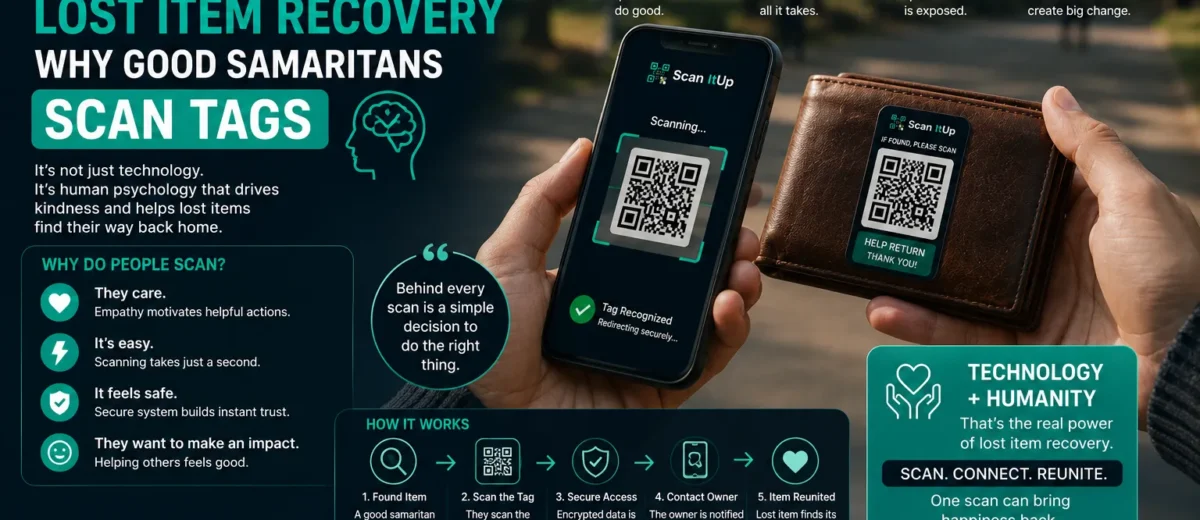
But then she noticed a small sticker on the inside flap — a QR code with two words printed beneath it in bold: SCAN ME.
Curiosity won. She set down the tray, pulled out her phone, and pointed the camera at the code. A clean page loaded instantly — a man’s name, a photo, and a big green WhatsApp button. She tapped it. A pre-filled message appeared: “Hi, I found your wallet. It has a Scan It Up tag.”
She hit send.
Eleven minutes later, a man named Arjun jogged across the food court, slightly out of breath, slightly embarrassed, and enormously relieved. He’d been in the electronics store two floors up, completely unaware that his wallet had slipped out of his back pocket.
No lost-and-found counter. No PA announcement that nobody listens to. No handing it to a waiter who puts it in a drawer and forgets. Just a scan, a message, and a reunion before Meera’s paneer went cold.
Here’s the part that matters — the part this article is really about: Meera was going to walk away. She had every reason to. She was busy, it wasn’t her responsibility, and the traditional process for returning a found wallet is awkward, time-consuming, and uncertain. But a two-second scan reduced the entire process to a single tap. And that tiny reduction in effort activated something deep in human psychology — something that was already there, waiting to be triggered.
This is the story of why good people return lost things. And more importantly, it’s the story of why they often don’t — and what changes when you make helping effortless.
What Actually Happens in Your Brain When You Find Something?
The moment you spot a lost item — a phone on a park bench, a set of keys on an auto-rickshaw seat, a bag left behind at a café — your brain initiates a rapid, mostly unconscious psychological sequence that determines what you do next.
The Three-Second Mental Calculation
Behavioural psychologists call this a cost-benefit analysis of helping, and it happens faster than you can consciously process it. Within seconds of recognising that an item belongs to someone else, your brain evaluates:
- How much effort will returning it require? Do I need to find a lost-and-found? Wait around for the owner? Carry this item with me? Fill out a form?
- What’s the social risk? Will people think I stole it? Will the owner accuse me of taking something from it? Will I look suspicious?
- Is there a clear path to action? Do I know how to return this? Is there a number to call? A person to hand it to? Any visible instruction?
If the answers to these questions feel expensive — too much effort, too much risk, too much ambiguity — your brain quietly overrides your good intentions and tells you to keep walking. Not because you’re a bad person. Because you’re a busy person whose cognitive bandwidth has been consumed by a dozen other concerns today.
This is the critical insight that most lost-and-found systems completely ignore: the bottleneck in lost item recovery is almost never honesty. It’s friction.
Empathy Activates — But Only If You Let It
Psychologists studying prosocial behaviour have long understood that empathy — the ability to imagine yourself in another person’s situation — is the primary emotional driver behind helping behaviour. When you find someone’s wallet, part of your brain instinctively simulates what it would feel like to lose yours. The panic. The cancelled cards. The missing ID. That emotional resonance creates a powerful urge to help.
But here’s the catch: empathy competes with every other demand on your attention. If you’re rushing to catch a train, arguing with a coworker on the phone, or managing a toddler through a crowded market, your empathic response gets suppressed — not eliminated, just drowned out by louder cognitive signals.
The psychology of lost item recovery isn’t about whether people want to help. Research overwhelmingly shows that they do. It’s about whether the environment gives their empathy enough room to breathe — and enough infrastructure to act on.
The Landmark Lost Wallet Study That Changed Everything We Assumed
In 2019, a team of researchers led by Alain Cohn at the University of Michigan conducted one of the largest field experiments in the history of behavioural economics. They “lost” over 17,000 wallets across 355 cities in 40 countries — and the results upended decades of assumptions about human honesty.
What They Found
The wallets were turned in at public institutions — banks, hotels, police stations, museums. Some contained no money. Some contained a small amount. And some contained a relatively large sum.
Here’s where it gets fascinating:
- 40% of wallets with no money were reported by the person who received them
- 51% of wallets with a small amount of money were reported
- 72% of wallets with a large amount of money were reported
Read that again. The more money the wallet contained, the more likely people were to return it. This directly contradicts the prediction of classical economics, which assumes that people act in rational self-interest and would pocket the cash.
Why More Money Meant More Honesty
The researchers identified two psychological forces at work:
Altruistic concern: As the stakes for the owner increased (more money lost), the finder’s empathy intensified. Keeping a wallet with ₹200 feels like a small transgression. Keeping one with ₹5,000 feels like causing genuine harm to another person.
Self-image as a thief: This is the more powerful mechanism. Humans have a deep psychological need to maintain a positive self-concept. Keeping an empty wallet feels like finding an abandoned item. Keeping a wallet full of money? That feels like stealing. And most people — across cultures, income levels, and geographies — will go to significant lengths to avoid seeing themselves as a thief.
What This Means for Lost Item Recovery
The wallet study revealed something that lost-and-found system designers have long overlooked: people don’t need to be incentivised to be honest. They need to be given a frictionless way to act on the honesty they already possess.
In the study, the “friction” was already low — the finder just needed to tell the receptionist at the counter. But in real life, returning a lost item found on a park bench, in a taxi, or at a railway station involves dramatically more effort. You have to locate an authority, explain the situation, possibly fill out paperwork, and invest time with no guarantee the owner will ever get their item back.
When a QR tag on a personal item reduces that entire process to a two-second scan and a single tap on WhatsApp, you’re not just adding a feature. You’re removing the psychological barrier between the finder’s good intentions and their actual behaviour.
Five Psychological Forces That Turn Finders Into Returners
Understanding why people return lost items isn’t just academic curiosity. It’s the behavioural blueprint for designing recovery systems that actually work. Here are the five forces at play — and how smart QR tags activate each one.
1. Empathic Projection — “I Know How This Feels”
The most immediate and powerful motivator. The finder mentally simulates losing their own wallet, phone, or bag, and the emotional discomfort of that simulation drives them to act. Research in social psychology consistently shows that empathic projection increases in proportion to the perceived value of the item — not just monetary value, but personal significance.
A family photograph in a wallet. A child’s name engraved on a lunchbox. A medical emergency card inside a bag. These signals tell the finder that this item matters deeply to someone — and that recognition amplifies the empathic response.
How QR tags activate this: When a finder scans a smart QR tag and sees a real person’s name, their photo, and details that humanise the owner, the empathic connection intensifies. The owner stops being an abstraction and becomes a real person with a real face — making it psychologically harder to walk away.
2. Identity Maintenance — “I’m Not the Kind of Person Who Keeps Things”
The lost wallet study identified this as the dominant mechanism. Humans construct narrative identities — stories about who they are — and maintaining consistency with those stories is a powerful motivational force. Most people see themselves as honest, decent, and trustworthy. Keeping a found item contradicts that narrative and creates a state psychologists call cognitive dissonance — the uncomfortable feeling of behaving in a way that conflicts with your self-concept.
Returning the item resolves the dissonance. It lets you walk away feeling good about who you are. That psychological reward — the warm glow of integrity — is often more valuable than whatever the item is worth.
3. Social Norm Activation — “People Like Me Do the Right Thing”
We’re social creatures who calibrate our behaviour based on what we believe others would do in the same situation. When a found item carries a clear “SCAN ME” label or a visible recovery tag, it signals that a social system exists for returning items — that doing so is normal, expected, and practiced by others. This is the power of social proof applied to prosocial behaviour.
A QR tag with professional design and clear instructions communicates: other people scan these. Other people help. This is what decent humans do. And that message activates a finder’s desire to align with their social group.
4. Reciprocal Expectation — “Someday I Might Be the One Losing Something”
Reciprocal altruism — the expectation that helping others will eventually be reciprocated — is one of the deepest evolutionary drives in human psychology. When someone returns a lost item, part of their motivation is an unconscious belief that the universe of good behaviour will come around to protect them when they’re in a similar situation.
This isn’t cynical calculation. It’s a deeply ingrained social instinct that predates modern civilisation. And it activates most strongly in environments where there’s a visible system of mutual care — like a tag that says, in effect, “Someone took the time to protect this item. Now it’s your turn to help.”
5. The Endowment of Responsibility — “Now That I’ve Found It, It’s My Job”
This is a subtler but surprisingly powerful force. The moment a person picks up a lost item or reads a “SCAN ME” tag, they experience what psychologists call an endowment of responsibility — a feeling that they are now personally accountable for the item’s fate. Walking away after engaging with the item feels like an active choice to abandon it, which triggers guilt.
How QR tags amplify this: A blank, anonymous item is easy to ignore — diffusion of responsibility lets you assume someone else will handle it. But a tagged item with clear instructions assigns the responsibility directly to you. It personalises the moral situation. And personalisation, as decades of behavioural research confirm, is one of the most powerful drivers of action.
The Friction Problem — Why Good Intentions Die in Silence
Here’s a statistic that should reshape how you think about lost belongings: studies on lost-and-found systems at airports, transit hubs, and public venues consistently show that only 15–25% of lost items are ever reunited with their owners. Not because 75% of finders are dishonest. But because the process of returning an item is, in most environments, frustratingly difficult.
The Six Frictions That Kill Recovery
Every step between “I found something” and “the owner has it back” introduces a point where the finder can — and often does — give up:
- Identification friction — no name, number, or marking on the item; the finder has no idea who owns it
- Communication friction — even if there’s a name, how do you contact them? Social media search? A PA announcement nobody hears?
- Effort friction — carrying the item to a lost-and-found counter, waiting in line, explaining the situation
- Time friction — the finder is busy, running late, dealing with their own life
- Social friction — fear of being accused of theft, awkwardness of approaching a stranger, embarrassment
- Trust friction — handing the item to a third party (security guard, receptionist) with no guarantee it reaches the owner
Each of these frictions operates independently. A finder might overcome the identification barrier but stumble at the effort barrier. They might be willing to invest the time but not the social risk.
What Happens When You Remove All Six
A QR tag on luggage, a bag, or a personal item removes every one of these barriers in a single design:
- Identification: The tag identifies the item as owned and provides owner details
- Communication: One tap connects the finder to the owner via WhatsApp — no number search, no PA system
- Effort: The entire return process takes under 30 seconds from scan to message
- Time: No waiting, no forms, no lines — just a scan while standing next to the item
- Social: The process is private and digital — no awkward face-to-face interaction required
- Trust: The finder contacts the owner directly — no intermediary who might lose the item again
This is why QR tags increase lost item return rates so dramatically. They don’t make people more honest. They remove the reasons honest people fail to act.
How QR Tags Exploit Human Psychology to Get Your Stuff Back
The word “exploit” is deliberate here — not in a manipulative sense, but in the sense that smart QR tag systems are designed to work with the grain of human psychology, activating the right impulses at the right moment.
The “SCAN ME” Trigger — Behavioural Prompts in Action
In behavioural design, a prompt is a signal in the environment that triggers a specific action. A doorbell says “press me.” A pedestrian crossing signal says “walk now.” A “SCAN ME” label on a QR tag says “point your phone here.”
This is not a trivial design choice. Without a prompt, a finder staring at a QR code might not know what it is, might assume it’s a product label, or might not think to scan it. The two words “SCAN ME” — printed in Hindi and English on platforms like Scan It Up — transform a passive pattern of black squares into an active invitation to help.
Research on behavioural prompts shows that clearly labelled action triggers increase compliance rates by 40–60% compared to unlabelled alternatives. The difference between a QR code and a QR code that says “SCAN ME” is the difference between a locked door and an open one.
The Instant Gratification Loop
When the finder scans the tag and the owner’s profile loads — a real name, a real face, a big green WhatsApp button — the finder experiences immediate psychological reward:
- Curiosity satisfied — “I wondered what this was, and now I know”
- Competence felt — “I figured out how to help”
- Connection established — “I can see who this belongs to”
- Action enabled — “One tap and I’ve done a good thing”
This rapid sequence — from curiosity to action in under 10 seconds — creates what behavioural psychologists call a completion loop. Once you’ve started the process (scanning), your brain wants to finish it (sending the message). Abandoning the process mid-loop creates discomfort. Completing it creates satisfaction.
Privacy as a Catalyst, Not Just a Feature
Here’s a counterintuitive insight: privacy protection for the owner actually increases the finder’s willingness to help.
When a lost item displays the owner’s raw phone number — on an engraved tag, a luggage label, or a dashboard note — the finder faces an implicit social burden. Calling a stranger’s personal number feels intrusive. Texting an unknown number feels awkward. Many finders, particularly in cultures where unsolicited contact is considered rude, will hesitate.
A QR tag that routes communication through a privacy-protected relay system removes this hesitation. The finder taps a button. The owner gets a message. Nobody’s personal number is exposed. The entire interaction is framed as using a system — not as one stranger contacting another. That framing matters enormously to the finder’s comfort level.
Traditional Recovery vs QR Tag Recovery — A Behavioural Comparison
If you’re weighing whether to tag your belongings, this comparison frames the decision through the lens of what actually happens psychologically when someone finds your item:
| Dimension | Traditional Recovery (No Tag / Engraved Tag) | QR Tag Recovery (Scan It Up) |
| Finder’s first thought | “I don’t know whose this is” | “This belongs to someone — and I can reach them” |
| Identification | No owner info, or a name etched in tiny text | Owner’s name, photo, and contact — instant recognition |
| Communication path | Call an unknown number, find security, post on social media | One-tap WhatsApp — private, fast, zero awkwardness |
| Time investment for finder | 10–30 minutes (finding lost-and-found, waiting, explaining) | Under 30 seconds (scan → tap → done) |
| Social discomfort | High — calling strangers, handing items to staff, fear of accusation | Minimal — digital, anonymous, system-mediated |
| Completion rate | Low — most finders give up before reaching the owner | High — the process is so fast that abandonment is rare |
| Owner notification | None — you discover the loss hours or days later | Instant — app alert, email, WhatsApp notification with scan location |
| Privacy for owner | ❌ Phone number exposed on tags, labels, notes | ✅ Number completely hidden behind privacy relay |
| Privacy for finder | ❌ Must share their identity when handing item to staff | ✅ Can help anonymously through the message form |
| Works across languages | ❌ Engraved text in one language only | ✅ Scan page and messages work in any language |
| Works across cities/countries | ❌ Lost-and-found systems are local and disconnected | ✅ QR tag works globally — scan from any country, any phone |
| Psychological reward for finder | Delayed and uncertain — “I hope they got it back” | Immediate — “I just sent the message; they know I found it” |
The difference between traditional lost-and-found and QR-tag recovery isn’t technological. It’s psychological. One system fights human nature. The other flows with it.
Real Moments Where a Scanned Tag Changed Everything
Psychology studies are convincing. But real stories are what make the principles tangible.
The Laptop Bag at Bangalore Airport
Vikram, a software consultant, left his laptop bag at the security belt at Kempegowda International Airport while rushing to catch a delayed Indigo flight. Inside: a MacBook Pro, two hard drives with client data, his passport, and his car keys.
He didn’t notice until he was seated on the plane. Gate closed. Phone on airplane mode. Heart sinking.
But Vikram had done one thing three months earlier that he barely remembered: he’d stuck a Scan It Up QR tag on the inside pocket of his bag — the same way he tags his luggage and wallet.
A CISF officer at the security belt found the bag during a sweep. He noticed the QR sticker, scanned it out of curiosity, and tapped the WhatsApp button. By the time Vikram landed in Delhi and turned his phone back on, he had a message with a photo of his bag and a contact number for the security office.
The bag — with the MacBook, the hard drives, and the passport — was couriered to him the next day.
“The officer told me later that he almost just logged it in the airport lost-and-found,” Vikram says. “But the sticker said SCAN ME, and it was faster to scan than to fill out their form. That laziness — his, not mine — saved my entire client project.”
The Keys in the Auto-Rickshaw
Sneha dropped her house keys in a Bangalore auto-rickshaw. She only realised when she reached her apartment door. No idea which auto. No receipt. No way to trace the driver.
Her keychain had a small Scan It Up tag attached — she’d ordered a set of personal item QR tags when she first moved to the city, partly because her mother had insisted.
The auto driver found the keys wedged in the back seat during his next passenger drop. He scanned the tag, and the WhatsApp message reached Sneha within minutes. He drove back to her apartment and returned the keys — and she tipped him ₹200, which he tried to refuse.
“He said he just scanned because the sticker looked official,” Sneha recalls. “He thought it was something government-related. He didn’t even know it was a personal tag. But it worked.”
The Child’s School Bag on the Metro
A mother in Delhi tagged her eight-year-old daughter’s school bag after the child left it on the Metro for the third time in six months. The next time it happened — predictably, within two weeks — a college student found the bag, scanned the tag, and messaged the mother before the child even reached home.
The student later told the mother: “I found the bag and my first thought was, I’ll hand it to the station staff. But then I saw the QR code and I thought — this will be faster. And it was. I just scanned and messaged you. The whole thing took maybe twenty seconds.”
Twenty seconds. That’s the difference between a recovered school bag and another evening of panic, retracing steps, and filing a complaint at the Metro lost-and-found office.
The Bystander Effect and How Smart Tags Defeat It
One of the most well-documented phenomena in social psychology is the bystander effect — the tendency for individuals to be less likely to help when other people are present. The more bystanders, the less any single person feels personally responsible for acting.
Why Crowds Make People Walk Past Lost Items
When you find a wallet on a busy train platform, your brain unconsciously performs a responsibility calculation: “There are fifty people here. Surely someone else noticed. Someone closer to the lost-and-found. Someone with more time. Someone who works here.”
This diffusion of responsibility means that in the environments where items are most frequently lost — crowded public spaces — the very conditions that increase the likelihood of loss simultaneously decrease the likelihood of recovery.
How a QR Tag Breaks the Diffusion
A visible QR tag with a clear “SCAN ME” instruction does something psychologically powerful: it personalises the responsibility. The moment you read those words, the diffusion evaporates. The tag is speaking directly to you. Not to the crowd. Not to the security guard. To you, the person standing two feet away with a smartphone in your pocket.
This is why the design of recovery tags matters enormously. A blank QR code can be ignored — it could be anything. But a branded, labelled tag with “SCAN ME” in multiple languages transforms a passive object into an active request. It assigns the responsibility, reduces the ambiguity, and makes action feel both easy and expected.
In behavioural design terms, the tag acts as a commitment device. Once you’ve read “SCAN ME” and recognised that the item is lost, walking away requires actively choosing not to help — a much harder psychological act than passively not noticing.
What Makes Scan It Up the System Built for Human Nature
Most lost-and-found systems are designed around logistics — collection points, databases, reporting forms. Scan It Up is designed around people.
Every feature in the platform maps to a specific insight from the psychology of lost item recovery:
Instant WhatsApp Contact — Because Speed Matters
The gap between finding an item and sending a message needs to be measured in seconds, not minutes. Scan It Up places a prominent WhatsApp button on every scan page — pre-filled with a message so the finder doesn’t even need to type. One tap. The finder’s good intention is converted to action before their cognitive load catches up and tells them to keep walking.
Owner Photo and Name — Because Humanisation Drives Empathy
When the scan page displays the owner’s name and photo, the item stops being an anonymous object and becomes a person’s belonging. Research consistently shows that humanising the victim of a situation — putting a face to the need — dramatically increases helping behaviour. Scan It Up uses this principle intentionally: every profile includes a name, a photo, and contextual details that make the owner real.
Privacy Relay — Because the Finder Needs Comfort Too
The finder’s willingness to help depends partly on their own comfort level. Calling a stranger’s personal phone number feels intrusive. A privacy-protected relay — where communication flows through WhatsApp buttons, call masking, and secure message forms without exposing anyone’s personal number — reduces the finder’s social anxiety and increases their likelihood of reaching out.
29+ Professional Sticker Designs — Because Appearance Signals Legitimacy
A generic black-and-white QR code could be anything — a product label, a warranty card, a spam link. Scan It Up’s professionally designed sticker templates with clear bilingual “SCAN ME” instructions communicate legitimacy, trust, and purpose. The finder sees a system, not a mystery. And systems feel safe to engage with.
Real-Time Scan Notifications — Because Feedback Completes the Loop
When the owner receives an instant notification — the scan location, the time, the finder’s message — it closes the psychological loop for both parties. The owner knows their item has been found. The finder knows their message was received. Both parties experience the satisfaction of a completed interaction, which reinforces the behaviour for future encounters.
A Connected Protection Ecosystem
Scan It Up isn’t a single-item solution. It’s a complete smart digital identification and recovery platform powered by QR technology that protects:
- Personal items — wallets, keys, glasses, headphones
- Bags and luggage — suitcases, backpacks, laptop bags
- Pets — dog collars, cat tags, bird cages
- Vehicles — cars, bikes, scooters, auto-rickshaws
- Medical emergency IDs — blood group, allergies, emergency contacts
- Kids and senior safety — identification for vulnerable family members
- Electronics — laptops, tablets, cameras
One account. One dashboard. Every important item in your life, protected by the same psychology-informed system.
How to Protect Everything You Own Using Behavioural Science
Understanding the psychology is illuminating. Acting on it is what matters. Here’s a practical framework — grounded in everything we’ve discussed — for maximising the chances that your lost items find their way home.
Make Identification Instant
- Tag every high-value item with a Scan It Up QR tag — wallet, keys, laptop bag, luggage, phone case
- Include your photo and name in every profile — humanisation increases return rates
- Add a custom message in multiple languages — Hindi, English, and your regional language at minimum
Reduce the Finder’s Effort to Zero
- Use tags with clear “SCAN ME” instructions — don’t assume finders know what a QR code does
- Enable WhatsApp contact — it’s the lowest-friction communication channel in India and increasingly worldwide
- Keep your profile updated — a disconnected phone number or outdated information kills the recovery at the last step
Activate the Right Psychology
- Place tags where they’re visible — inside wallet flaps, on luggage handles, on keychain fobs, on bag zippers. If the finder can’t see the tag, the psychology can’t activate
- Choose professional-looking sticker designs — appearance signals trust. A sketchy-looking tag creates doubt
- Test your tags periodically — scan them yourself to ensure the link works and information is current
Build a Personal Recovery Ecosystem
- Tag your pet’s collar with the same platform you use for your wallet
- Tag your vehicle so strangers can reach you about parking issues or emergencies
- Create a medical emergency QR card for yourself and elderly family members
- Brief your family — make sure your spouse, children, and parents have their own tagged items
The goal isn’t paranoia. It’s preparation. You can’t predict when you’ll leave your bag in a rickshaw or your wallet at a billing counter. But you can ensure that when it happens, the stranger who finds it has a frictionless path to getting it back to you.
Frequently Asked Questions
Why do people return lost items instead of keeping them?
People return lost items primarily because of two powerful psychological forces: empathic projection (imagining how they’d feel if they lost something) and self-identity maintenance (the desire to see themselves as honest and trustworthy). Research from the landmark 2019 “Civic Honesty around the Globe” study — which tracked over 17,000 lost wallets across 40 countries — found that people were actually more likely to return wallets containing more money, because keeping them created a stronger feeling of “being a thief,” which most people psychologically refuse to tolerate.
What is the psychology behind good samaritans scanning QR tags?
When a finder sees a QR tag with a “SCAN ME” label, several psychological mechanisms activate simultaneously. Curiosity drives the initial scan. Empathy intensifies when the scan page reveals a real person’s name and photo. And the ultra-low friction of the process — one tap to send a WhatsApp message — allows the finder to act on their helping impulse before competing cognitive demands (time pressure, effort avoidance) can suppress it. In behavioural terms, QR tags reduce the psychological “cost” of helping to near zero.
How do QR tags increase lost item return rates?
QR tags increase return rates by systematically eliminating the six major frictions that prevent honest finders from acting: identification friction (who owns this?), communication friction (how do I reach them?), effort friction (how long will this take?), time friction (I’m busy), social friction (this feels awkward), and trust friction (will the item actually get back to the owner?). By compressing the entire return process to a 10-second scan-and-message sequence, QR tags convert good intentions into completed reunions.
What percentage of lost items are typically returned to their owners?
Studies across airports, transit systems, and public venues show that only 15–25% of lost items are reunited with their owners through traditional lost-and-found systems. The low rate isn’t primarily due to dishonesty — it’s due to friction. Most finders want to help but lack a clear, quick way to contact the owner. Items with visible identification tags, smart QR codes, or embedded contact systems show significantly higher recovery rates because they remove the barriers between good intentions and action.
Does making it easier to help actually make people more helpful?
Yes — this is one of the most replicated findings in behavioural psychology. The “Good Samaritan” studies (originally conducted at Princeton in 1973 and replicated globally since) demonstrated that situational factors — especially time pressure and ease of helping — are stronger predictors of helping behaviour than personality traits. When you reduce the effort required to help — as QR tags do by making contact a one-tap process — you dramatically increase the probability that people will follow through on their natural prosocial instincts.
How does a QR tag system like Scan It Up protect the privacy of both the finder and the owner?
Scan It Up uses a privacy-protected relay architecture. The owner’s phone number is never displayed on the scan page — finders contact the owner through WhatsApp buttons, masked call routing, or a secure message form. The finder can also remain anonymous if they choose, sending a message through the form without sharing their own number. This dual privacy protection is psychologically important: research shows that finders are significantly more likely to reach out when the process feels safe and non-intrusive for both parties.
Can QR tags work for items lost in another city or country?
Absolutely. Unlike physical lost-and-found systems, which are local and disconnected, a QR tag links to a web-based profile accessible from any smartphone with internet access — regardless of city, state, or country. If you lose your bag in Mumbai and someone finds it in Delhi, they scan the same tag, see the same profile, and contact you through the same WhatsApp button. This global accessibility is a fundamental advantage over traditional systems that depend on geographic proximity.
What types of items should I put QR tags on?
Focus on items that are frequently lost, difficult to identify without markings, and high-value (either financially or personally). The priority list includes: wallets and purses, keys and keychains, bags and backpacks, luggage and suitcases, laptops and tablets, pet collars, water bottles and lunchboxes (especially for children), and any item you regularly carry outside your home. Platforms like Scan It Up offer your first tag free, so you can start with your most important item and expand from there.
Every Lost Item Is a Test of Human Nature — And Humans Keep Passing
The research is clear. The stories are consistent. The pattern is unmistakable.
Most people, in most situations, want to do the right thing when they find something that doesn’t belong to them. The wallet study proved it across 40 countries. The behavioural psychology confirms it across decades of research. And the thousands of recovery stories from platforms like Scan It Up demonstrate it every single day.
The problem was never honesty. The problem was always friction.
A QR tag doesn’t change human nature. It doesn’t make people kinder or more honest than they already are. What it does — elegantly, simply, and in under ten seconds — is remove every obstacle between a stranger’s good intention and the small, quiet act of scanning a code and tapping a button.
That’s all it takes. A scan. A tap. A message that says, “I found your wallet.”
Create your first free QR tag on Scan It Up →
It takes three minutes. It costs nothing. And the next time you leave something behind — at a café, in an auto, on a train — it ensures that the good samaritan who finds it has everything they need to bring it home.
