
A busy metro station. A man in his 50s suddenly collapses. People gather. He is breathing, but barely responsive. No family nearby. No one knows his name, his medical history, his allergies, or whether he is on blood thinners.
Now imagine one difference: a visible medical QR ID card on his lanyard and in his wallet. Someone scans it. In seconds, responders can see critical details: diabetes, severe penicillin allergy, anticoagulant medication, and emergency contacts.
That is the gap a medical QR ID card fills.
Not convenience.
Not “nice to have.”
A critical bridge between confusion and correct care.
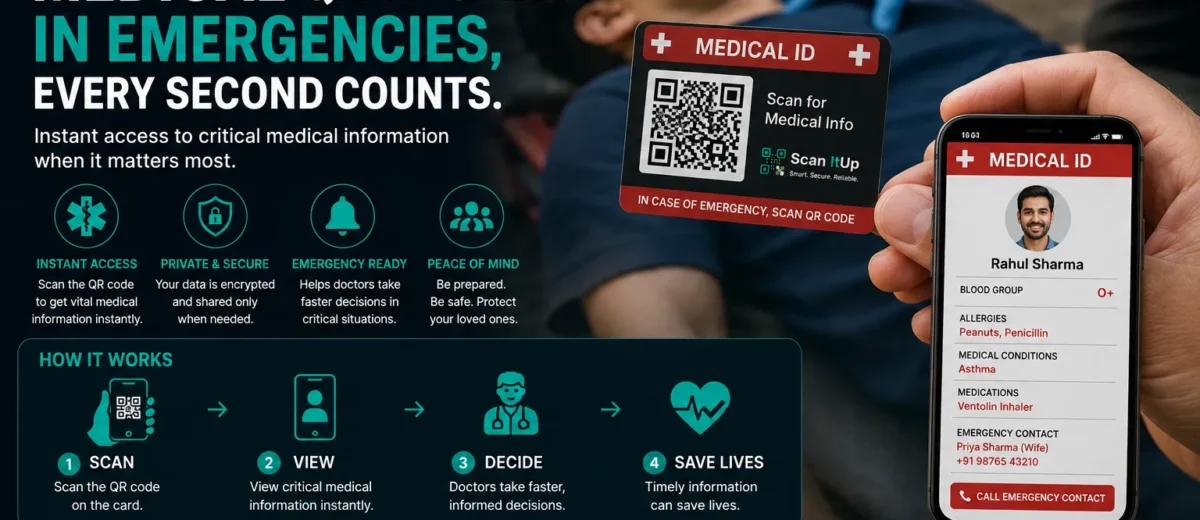
A medical QR ID card is a physical ID card with a scannable QR code linked to emergency health information. In a crisis where you cannot speak, it can quickly share your key medical facts with the people trying to help you.
Scan It Up positions this exactly where it belongs: a smart digital identification and recovery platform powered by QR technology.
Quick Answer: Can a Medical QR ID Card Really Save Your Life?
Yes, it can improve the odds of safer, faster emergency decisions by giving responders immediate access to information that changes treatment, such as:
- severe allergies
- blood group
- current medications (especially high-risk drugs)
- major conditions (diabetes, epilepsy, cardiac history)
- emergency contacts
It is not a replacement for hospital records. It is a first-response tool for the first critical minutes.
Why This Matters More Than Most People Realize
Emergency medicine is a time game. Early decisions are made before complete records are available.
- CDC data shows the U.S. had an estimated 155 million emergency department visits in 2022.
- WHO highlights that medication errors remain a major global patient-safety issue, with an estimated $42 billion annual cost.
- AHA/Red Cross first-aid guidance emphasizes rapid action in time-sensitive events like anaphylaxis, where early, correct intervention is essential.
In plain terms: when information is missing, risk goes up.
A medical QR ID card helps reduce that information gap in the moments when:
- you are unconscious
- speech is impaired
- family cannot be reached immediately
- your phone is locked, dead, or unavailable
How a Medical QR ID Card Works in a Real Emergency
1. You create a digital medical profile
You add the details that matter in emergency care: conditions, allergies, meds, blood group, and contacts.
2. You carry the QR physically
On a card, wristband, keychain, or badge. Physical visibility matters.
3. A responder or bystander scans the code
No app friction should be required for basic emergency display.
4. Critical details appear in seconds
The goal is quick, structured clarity, not a long medical history dump.
5. Contacts are notified
Family or caregivers can move faster and coordinate decisions sooner.
This is exactly why many emergency-information frameworks recommend keeping concise, accessible data with you at all times.
What Information Should Be on a Medical QR ID Card?
Most people either add too little or too much. The right approach: prioritize treatment-changing facts.
Use this priority structure
| Priority | Include This | Why It Matters in Emergencies |
|---|---|---|
| Critical | Severe allergies, anaphylaxis risk, blood thinners, diabetes type, seizure disorders | Directly affects immediate treatment choices |
| High | Current medications with dose basics, blood group, key diagnoses | Helps avoid dangerous interactions and delays |
| Important | Emergency contacts, primary physician/caregiver | Speeds coordination and consent pathways |
| Optional | Insurance, non-urgent history | Useful later, but not first-minute critical |
Best-practice formatting tips
- Keep language simple and scannable.
- Use clear condition labels (no vague shorthand).
- Highlight red-flag alerts at top: “NO PENICILLIN,” “ON BLOOD THINNERS,” “TYPE 1 DIABETES.”
- Review and update after every medication or diagnosis change.
Real-World Scenarios Where a Medical QR ID Card Can Change Outcomes
Scenario 1: Severe allergy in a restaurant
A guest goes into anaphylaxis. They cannot speak clearly. The scan page confirms known triggers and emergency instructions. Precious minutes are saved.
Scenario 2: Road accident with altered consciousness
Victim arrives with no verbal history. QR reveals anticoagulant use and cardiac history. Trauma decisions become safer, faster, and more targeted.
Scenario 3: Hypoglycemic episode while traveling alone
Bystanders identify diabetes and emergency contact from one scan. Family is informed early; responders have better context before hospital transfer.
Scenario 4: Senior with multiple chronic conditions
An elderly patient has a fall, appears confused, and cannot recall medications. QR profile provides condition list and caregiver contact immediately.
None of these cases require perfect technology. They require one thing: critical information available at the point of care.
Medical QR ID Card vs Other Emergency ID Options
A smart setup is usually layered, not either/or.
| Option | Speed | Info Depth | Update Ease | Typical Limitation |
|---|---|---|---|---|
| Engraved medical bracelet | Very fast visual cue | Low | Hard (re-engraving) | Limited character space |
| Phone Medical ID | Good if accessed | Medium | Easy | Phone may be locked, dead, or not checked first |
| Paper wallet card | Medium | Medium | Manual | Can become outdated quickly |
| Medical QR ID card | Fast + structured | High | Easy (digital updates) | Must be visible and kept current |
Practical recommendation
Use a hybrid model:
- Wearable cue (bracelet/lanyard/ID marker)
- Medical QR ID card
- Phone Medical ID backup
This gives you redundancy, which is exactly what emergencies demand.
How to Set Up a High-Trust Medical QR ID System (15-Minute Checklist)
Step 1: Prioritize your top 5 emergency facts
Start with what could change immediate care:
- severe allergy
- high-risk medication
- major condition
- blood group (if known)
- emergency contact
Step 2: Build your profile on Scan It Up
Set up your Medical Emergency QR profile with clear fields and visible emergency priorities.
Step 3: Place your QR where people will actually find it
- wallet card behind ID
- lanyard/work badge
- keychain tag
- travel pouch insert
Step 4: Run a real scan test
Ask a friend to scan and verify:
- page load speed
- clarity of top alerts
- contact flow
Step 5: Set a quarterly update reminder
Update after:
- new medication
- changed dosage
- new diagnosis
- changed emergency contacts
Privacy, Trust, and Safety: What Smart Users Do
People often worry: “If someone scans it, how much do they see?”
Good concern. The answer is controlled visibility.
Use a practical privacy model:
- show only emergency-relevant fields publicly
- hide sensitive non-emergency data
- never rely on “set and forget”
- re-check settings every few months
The goal is balance: enough information to protect you medically, without overexposing personal details.
Why This Also Builds a Family Safety Ecosystem
Medical emergencies rarely happen in isolation. Families need connected safety habits.
That is where Scan It Up’s wider QR ecosystem makes sense:
- Kids & senior safety QR tags for dependents
- Personal item QR tags for daily essentials
- Bags & luggage QR tags for travel continuity
- Vehicle QR tags for roadside context
- Pet QR tags for animal safety and return
This strengthens brand authority naturally: one platform, multiple real-life safety problems solved through QR identification and recovery.
Final Takeaway
A medical QR ID card is not about fear. It is about preparedness with dignity.
In emergencies, people do not need your full life story. They need the right facts, fast.
If you want a practical, low-friction starting point, create a Scan It Up Medical Emergency QR profile, test it once, and keep it updated.
Five minutes today can remove dangerous ambiguity tomorrow.
FAQs
What is a medical QR ID card?
A medical QR ID card is a scannable physical ID that opens your emergency health profile, including allergies, medications, conditions, and emergency contacts.
Do first responders actually use medical IDs and QR information?
Responders prioritize quick, visible cues. A clearly placed medical QR ID can support faster decisions, especially when the patient cannot communicate.
What are the most important details to include first?
Start with severe allergies, high-risk medications (like blood thinners or insulin), major conditions, blood group (if known), and emergency contacts.
Is a medical QR ID card better than phone Medical ID?
They work best together. QR cards are physically accessible and easy to spot; phone medical ID is a strong backup if responders can access the device.
How often should I update my medical QR profile?
Review every 3 months and immediately after any medication change, new diagnosis, or emergency contact update.
Can a medical QR ID card help people with diabetes, epilepsy, or heart conditions?
Yes. These conditions often require immediate context during emergencies, and a QR profile can provide that context quickly.
Where should I carry my medical QR ID card?
Keep it in high-visibility locations: wallet behind ID, lanyard badge, keychain tag, and travel pouch. Redundancy improves access.
Is my information public to everyone?
You control what is shown. Best practice is to expose only emergency-use fields and keep non-essential personal details private.
