
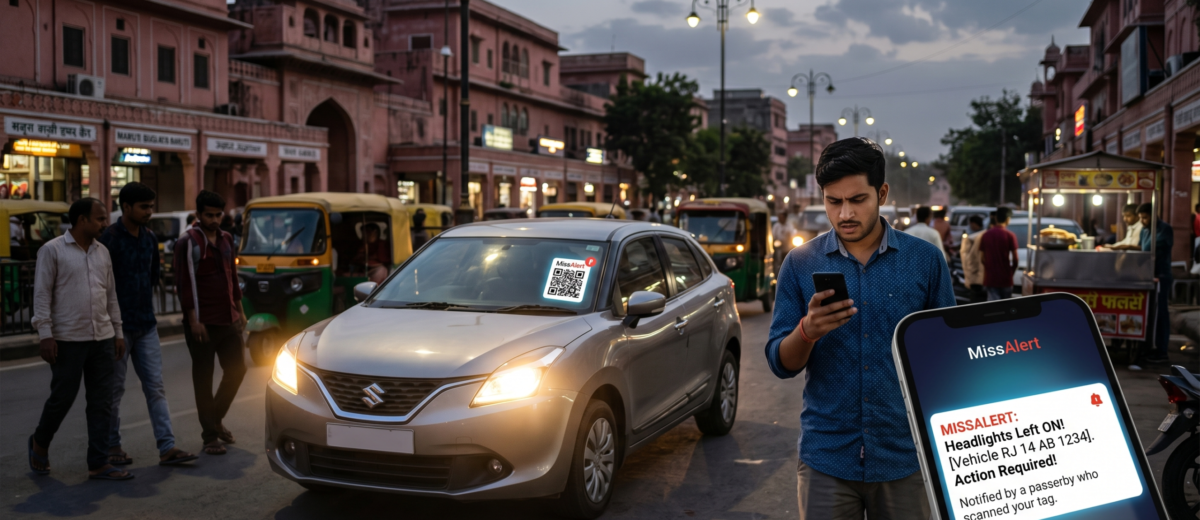
Car Headlights Left On? Here’s Exactly What Happens to Your Battery — and How to Prevent It
It’s one of those mistakes that feels small in the moment but can ruin your entire day. You park the car, you’re in a hurry, you grab your bags and rush inside. An hour later — or sometimes the next morning — you turn the key and nothing happens. Dead battery.
Leaving your car headlights on is one of the most common causes of battery drain among Indian drivers. And unlike a flat tyre, which is immediately visible, draining headlights offer no warning sign until it’s too late.
This guide covers everything you need to know: how long your battery lasts with headlights on, what to do when you return to a dead battery, and the most effective ways to prevent this from happening in the first place.
This depends on your battery’s capacity and the type of headlights your vehicle uses. Here’s a practical breakdown:
Standard Halogen Headlights
Most Indian cars are fitted with halogen headlights, which draw approximately 55 watts per bulb — so around 110 watts total for both. A standard 45Ah car battery can power halogen headlights for roughly 4 to 5 hours before becoming too depleted to start the engine.
LED Headlights
LED headlights are significantly more efficient, drawing around 20–30 watts total. This extends battery life to approximately 8 to 12 hours before critical depletion. However, a completely drained battery still won’t start your car.
DRL (Daytime Running Lights)
Daytime running lights use even less power — sometimes as little as 10 watts. But left on overnight, they will absolutely drain your battery by morning.
The key takeaway: there is no ‘safe’ amount of time to leave headlights on unattended. Even if your car has auto-off headlights, older or budget models in India often don’t.
What Happens to Your Battery When Headlights Are Left On?
A car battery is a lead-acid unit that’s designed for high-current bursts, not sustained low draws. When headlights drain it over several hours, a process called deep discharge occurs. This doesn’t just leave you stranded — it can permanently damage the battery.
Immediate Effects
- Engine will not start — not enough current for the starter motor.
- All electrical systems become unresponsive (windows, AC, radio).
- Interior lights may flicker or fail.
Long-Term Battery Damage
A battery that’s deeply discharged once may recover with a jump-start. But repeated deep discharges permanently reduce battery capacity. In Indian climatic conditions — especially extreme summer heat in states like Rajasthan and Gujarat — heat-stressed batteries fail even faster when deep discharged.
A new car battery in India typically costs between ₹3,000 and ₹8,000 depending on brand and capacity. A preventable mistake becomes an expensive repair.
What to Do If You Find a Dead Battery
Option 1: Jump-Start the Battery
This is the most common fix. You’ll need jump-start cables and another vehicle with a charged battery. Connect positive-to-positive and negative-to-negative terminal, let the good battery charge yours for 2–3 minutes, then start your car.
If you drive for at least 20–30 minutes after jump-starting, your alternator will recharge the battery sufficiently. Avoid turning off the engine too quickly after a jump-start.
Option 2: Roadside Assistance
Most car insurance policies in India include roadside assistance. Services like MG Motor Assist, Tata Motors Connect, or third-party providers like Safe Drive offer battery jump-starts and towing. Keep your insurer’s helpline number saved.
Option 3: Portable Battery Pack
Compact lithium-ion jump-start packs are now widely available in India for ₹2,000–₹5,000. They fit in your glove box and can jump-start a car without needing another vehicle. Highly recommended for frequent drivers.
Why Headlights Are Left On More Often Than You Think
Modern cars in Europe and North America have automatic headlight shut-off systems. But many budget and older vehicles popular in India — including older Maruti Suzuki, Hyundai, and Tata models — do not have this feature.
Common scenarios where headlights are accidentally left on:
- Daytime parking in an underground car park or covered space (headlights turned on for visibility, forgotten after)
- Headlights turned on during rain or dust storm and forgotten after parking
- Getting distracted by a call, child, or urgent errand immediately after parking
- Driver unfamiliar with the vehicle — rental cars, borrowed vehicles
The Smartest Solution: Real-Time Headlight Alerts
Technology has now made it possible to receive an alert about your headlights within seconds of parking — from a complete stranger, without sharing any personal information.
Scan it Up’s smart QR vehicle tag allows any passerby, parking attendant, or helpful neighbour to instantly notify you if your headlights are left on. They scan the tag on your vehicle, select ‘Headlights Left On’ from the alert menu, and you receive a push notification immediately.
One Scan it Up user in Delhi, Priya Sharma, reported that the system has already saved her from roadside assistance calls at least four times. That’s potentially ₹12,000+ saved in battery replacement costs alone.
6 Practical Tips to Prevent Leaving Headlights On
- Build a parking checklist habit: Before getting out of your car, always check headlights OFF, handbrake ON, windows UP.
- Set a phone reminder if you park somewhere unusual or in low-light conditions.
- Place a sticky note on your dashboard near the headlight switch as a visual reminder — old-school but effective.
- Consider upgrading to a vehicle with automatic headlight cut-off if you frequently forget.
- Install a QR vehicle tag (like Scan it Up) so bystanders can alert you anonymously when you do forget.
Keep a portable jump-start pack in the vehicle as a last-resort backup.

Conclusion: Don’t Let a Forgetful Moment Cost You Thousands
Leaving your car headlights on is a common, human mistake. But with the right habits and tools, it doesn’t have to cost you a battery replacement or a stressful roadside breakdown experience.
Alert QR vehicle tag, and you’ll have a network of helpful strangers who can alert you the moment something goes wrong — anonymously, instantly, and at zero cost to you.
Frequently Asked Questions
Q: Can leaving headlights on overnight ruin a car battery permanently?
A: Yes, it can. A complete overnight discharge puts a car battery through a deep discharge cycle. While a single incident may not cause permanent damage, repeated deep discharging significantly reduces battery life and capacity. In hot Indian climates, deeply discharged batteries degrade even faster.
Q: Is it safe to drive immediately after jump-starting a car?
A: Yes, but don’t switch off the engine for at least 20–30 minutes. This gives the alternator time to recharge the battery. Avoid turning on high-draw accessories like AC, rear defogger, or high-beam headlights for the first few minutes after a jump-start.
Q: How does Scan it Up notify me about headlights left on?
A: Any bystander who notices your headlights are on can scan the Scan it Up QR tag on your vehicle with their smartphone camera — no app needed on their end. They select the ‘Headlights Left On’ alert type, and you receive an instant push notification through the Scan it Up app. Your phone number is never revealed.
