
Table of Contents
- Introduction: The Suitcase That Flew to São Paulo Without You
- What Is a Smart Luggage Tag and Why Does It Matter for International Travel?
- The Four Types of Smart Luggage Tags — And How They Actually Compare
- Why QR-Based Luggage Tags Are Winning the International Travel Game in 2026
- The International Travel Problem No One Talks About
- What to Look for in the Best Smart Luggage Tag for International Flights
- How a QR Luggage Tag Actually Works at an Airport — Step by Step
- Real Scenarios Where Smart Luggage Tags Saved International Trips
- Smart Luggage Tag vs Traditional Luggage Label — A Traveller’s Comparison
- How to Protect All Your Travel Gear — Not Just Your Suitcase
- Frequently Asked Questions
The email from Lufthansa was polite. Almost cheerful. “We regret to inform you that your checked baggage has been delayed and is currently being traced.”
Ravi was standing in the arrivals hall at Frankfurt Airport — 6,400 kilometres from home, midnight local time, wearing the same clothes he’d boarded in twelve hours earlier. His suitcase, containing a week’s worth of winter clothes, his blood pressure medication, his presentation slides on a USB drive, and a carefully wrapped anniversary gift for his wife, was somewhere between Mumbai and Munich. Maybe. The airline wasn’t sure.
He spent the next forty minutes in a queue at the baggage services counter. Filed a Property Irregularity Report. Received a reference number and a vague promise. Flew to his final destination in Berlin the next morning with nothing but a carry-on and a deepening sense of helplessness.
His suitcase arrived five days later. The anniversary dinner had already happened — without the gift. The presentation had been improvised from memory. The medication had been sourced from a Berlin pharmacy at three times the cost.
Here’s the part that gnaws at Ravi: his suitcase had a luggage tag on it. His name. His phone number. An Indian mobile number that nobody at a German airport was going to call.
What it didn’t have was a way for anyone — airline staff, airport ground crew, a fellow passenger at a connecting gate — to scan a code, tap a button, and tell Ravi exactly where his bag was in under thirty seconds.
That’s what a smart luggage tag does. And in 2026, if you’re crossing international borders with anything you can’t afford to lose, choosing the right one is no longer optional — it’s essential.
What Is a Smart Luggage Tag and Why Does It Matter for International Travel?
A smart luggage tag is a digital identification system attached to your bag that allows anyone who finds it to contact you instantly — without needing your phone number, your email, or any personal details at all.
Unlike a traditional paper tag or engraved metal label, a smart luggage tag uses technology — typically a QR code, NFC chip, Bluetooth beacon, or GPS module — to bridge the gap between a found bag and its owner. Instead of relying on airline systems, lost-and-found desks, or the goodwill of a stranger who happens to speak your language, a smart tag creates a direct, frictionless communication path.
For domestic travel, this is convenient. For international travel, it’s a fundamentally different proposition.
When your luggage crosses borders, the recovery equation changes completely. Language barriers multiply. Time zones create communication gaps. Airline baggage tracing systems — already strained — become even less reliable across carrier alliances and codeshare agreements. The lost-and-found infrastructure at a train station in Tokyo operates nothing like the one at Heathrow or Johannesburg.
A smart luggage tag cuts through all of that. It works in any country where someone has a smartphone — which, as of 2026, covers over 85% of the world’s population. One scan, one tap, one message. No translation needed. No forms. No queues.
That’s why the search for the best smart luggage tag for international travel has exploded over the past two years. Travellers aren’t just looking for a label. They’re looking for a recovery system that works at 3 AM in a language they don’t speak, in a country they’ve never visited, with zero setup required from the person who finds their bag.
The Four Types of Smart Luggage Tags — And How They Actually Compare
Not all smart luggage tags work the same way, and the differences matter enormously when you’re choosing one for international flights. Here’s a clear breakdown of the four main technologies available in 2026:
1. QR Code Luggage Tags
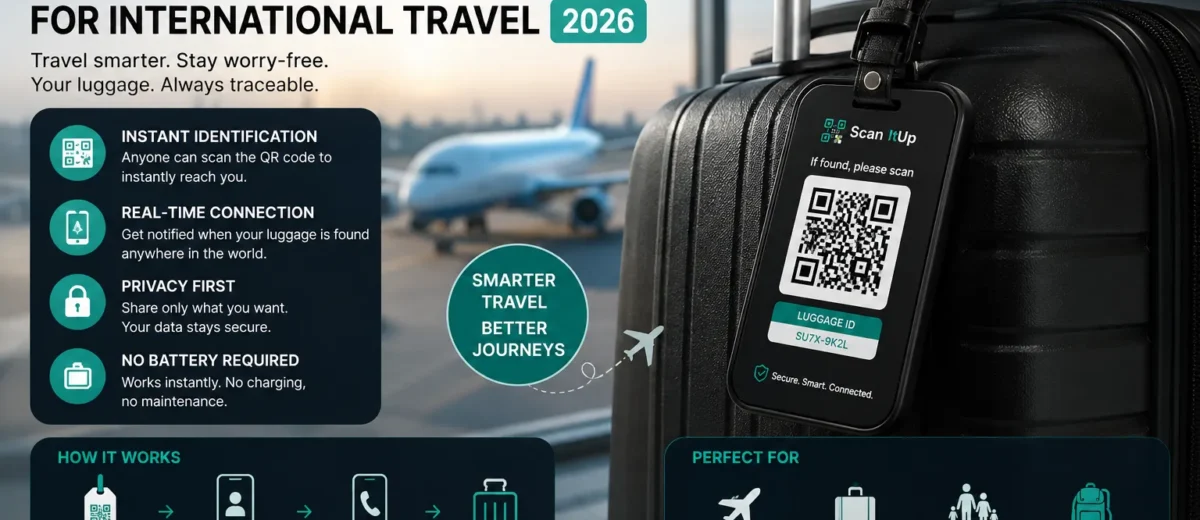
How they work: A unique QR code is printed on a durable sticker or tag and attached to your luggage. Anyone with a smartphone camera scans the code, which opens a secure web page displaying the owner’s contact options — WhatsApp, message form, or call button — without revealing any personal information.
Best for: International travel, frequent flyers, budget-conscious travellers, anyone who needs a tag that works globally without batteries or apps.
2. Bluetooth Luggage Trackers
How they work: Small Bluetooth modules (like Apple AirTag or Tile) placed inside luggage. They ping nearby devices in the tracker network and relay approximate location to the owner’s phone.
Best for: Tracking luggage within Bluetooth range (~10–30 metres) or in areas with dense tracker networks, primarily in North America and Western Europe.
Limitations for international travel: Tracker networks are sparse in most of Asia, Africa, South America, and Eastern Europe. Requires the owner’s app. Battery-dependent. Some airlines restrict lithium batteries in checked luggage.
3. GPS Luggage Trackers
How they work: Embedded GPS and cellular modules transmit real-time location data to the owner’s phone via a companion app.
Best for: High-value cargo, professional equipment, situations where real-time tracking is worth the cost.
Limitations for international travel: Expensive (₹5,000–₹15,000+). Requires a cellular data plan — often a different SIM for each country. Bulky. Battery life ranges from days to weeks, not months. Adds weight. Some airlines restrict cellular-enabled devices in checked luggage.
4. NFC Luggage Tags
How they work: A passive NFC chip embedded in a tag or card. When tapped with an NFC-enabled phone, it opens a webpage or transfers contact data.
Best for: Short-range identification, premium luggage brands that embed NFC chips at manufacturing.
Limitations for international travel: Requires physical contact (1–4 cm range). Many older smartphones don’t support NFC. No visual cue for the finder — unlike a QR code, there’s nothing to “scan” unless the finder already knows to tap.
Quick Comparison Table: Smart Luggage Tag Technologies for International Travel
| Feature | QR Code Tag | Bluetooth Tracker | GPS Tracker | NFC Tag |
| Works in every country | ✅ Yes — any smartphone camera | ⚠️ Limited — network-dependent | ⚠️ Needs local cellular plan | ⚠️ Phone must support NFC |
| Requires battery | ❌ No | ✅ Yes (6–12 months) | ✅ Yes (days–weeks) | ❌ No |
| Requires app download | ❌ No — opens in browser | ✅ Yes — owner + finder network | ✅ Yes — owner app required | ❌ No |
| Finder needs special device | ❌ No — any camera phone | ❌ No (passive network) | N/A (owner-tracked) | ✅ NFC-enabled phone only |
| Contact owner directly | ✅ Instant WhatsApp/message | ❌ No — location only | ❌ No — location only | ✅ If configured |
| Privacy protection | ✅ Number hidden | N/A | N/A | ⚠️ Depends on setup |
| Airline-safe for checked bags | ✅ No electronics | ⚠️ Varies by airline | ⚠️ Restricted by some airlines | ✅ Passive chip |
| Cost | Free–₹299 | ₹2,000–₹4,000 | ₹5,000–₹15,000+ | ₹500–₹1,500 |
| Setup time | 2 minutes | 10–15 minutes | 15–30 minutes | 5–10 minutes |
| Works without internet (finder) | ❌ Needs basic data/WiFi | ✅ Bluetooth proximity | N/A | ❌ Needs data for web link |
The takeaway: For international travel specifically, QR code tags offer the widest compatibility, zero maintenance, and the lowest barrier for the finder — the person whose cooperation you actually need when your bag is missing in a foreign country.
Why QR-Based Luggage Tags Are Winning the International Travel Game in 2026
The shift towards QR-based luggage identification isn’t a marketing narrative — it’s a practical response to how international luggage recovery actually works (and fails).
The Language Problem That GPS Can’t Solve
A GPS tracker can tell you where your bag is. But knowing your suitcase is sitting in a storage room at Istanbul Atatürk Airport doesn’t help if you’re in Zurich and can’t communicate with the ground crew in Turkish. GPS provides location data. It doesn’t provide communication.
A QR code on your luggage provides both. When ground staff, a fellow traveller, or a hotel housekeeper scans the code, they land on a clean, mobile-optimised page with a WhatsApp button, a message form, and a call option. The interface works in any language because the action is universal: scan, tap, connect.
The Battery Problem That International Trips Amplify
A two-week European backpacking trip. A three-week business rotation across Southeast Asia. A month-long family holiday in Australia. International trips are often longer than domestic ones — and Bluetooth trackers with 6-month battery life suddenly feel less reliable when you realise you haven’t replaced the battery in four months.
QR tags have no battery. No circuit. No charging cable. The sticker on your bag works the same on day one as it does on day three hundred. For international travel, where you need reliability across long durations and varied conditions, passive technology wins.
The “Finder Barrier” — The Most Overlooked Factor in Luggage Recovery
Here’s an insight that most luggage tracker reviews completely miss: the most important person in the recovery process isn’t you. It’s the stranger who finds your bag.
A Bluetooth tracker works silently — the finder doesn’t even know it’s there. A GPS tracker communicates with you, not with the finder. Both systems treat the finder as irrelevant.
But in real-world international luggage recovery, the finder is everything. They’re the airport porter in Manila who noticed your bag sitting uncollected. The hotel cleaner in Rome who found your backpack under the bed. The taxi driver in Nairobi who discovered your briefcase in the boot.
These people need one thing: a fast, obvious, zero-effort way to reach you. That’s precisely what a QR tag printed with “SCAN ME” provides — a universal call to action that works across languages, cultures, and technical literacy levels.
The International Travel Problem No One Talks About
Every year, airlines mishandle roughly 25 million bags globally. That’s the headline figure from SITA’s annual Baggage IT Insights report, which has tracked airline baggage performance for over a decade. While the rate has improved from its peak — down to about 6 bags per thousand passengers in recent years — the absolute numbers remain staggering.
But here’s what the SITA data doesn’t capture: the millions of bags lost outside the airline system entirely. Bags left in taxis, on trains, in hotel rooms, at restaurants, on cruise ships, in Airbnbs. These losses don’t appear in any airline report because they happen after the bag leaves the carousel.
For international travellers, these “non-airline” losses are often more devastating than a misrouted suitcase. An airline has a system — imperfect but functional — for tracing your bag. A taxi in Bangkok does not. A hostel in Lisbon does not. A metro system in Delhi does not.
Why Traditional Luggage Labels Fail Internationally
The standard paper luggage tag — the one with your name, address, and phone number — was designed for a world where travel was local and phone numbers were universal. In 2026, it fails internationally in at least four critical ways:
- Phone numbers don’t translate. Your Indian mobile number (+91) written on a tag means nothing to someone in Brazil who doesn’t know the country code, can’t afford international calling rates, or doesn’t want to phone a stranger in another time zone.
- Addresses are irrelevant. Your home address in Pune printed on a tag found in Singapore provides zero actionable information for recovery.
- Language locks you out. A tag written in Hindi is unreadable to 94% of the world’s population. Even English-only tags create barriers in non-English-speaking countries.
- Privacy is exposed. Your name, full address, and personal phone number — visible to anyone who picks up your bag — create a security risk, particularly for solo travellers and women travelling alone.
A digital luggage tag replaces all of this with a single, scannable code that adapts to the finder’s context: their language, their device, their communication preferences. No phone number exposed. No address visible. Just a clean interface that says, in every language: here’s how to reach the owner.
What to Look for in the Best Smart Luggage Tag for International Flights
Choosing a smart luggage tag for international travel isn’t about finding the most expensive or technically impressive option. It’s about finding the one that works reliably in the widest range of real-world scenarios — because when your bag goes missing in another country, “works most of the time” isn’t good enough.
Here are the seven non-negotiable features to prioritise:
1. Universal Compatibility — No Apps, No Special Hardware
The finder shouldn’t need to download an app, own a specific phone brand, or have NFC capabilities. The tag should work with any smartphone camera — Android or iPhone, budget or flagship, 2020 model or 2026 model.
2. Instant Communication — Not Just Location
Knowing where your bag is matters less than being able to talk to the person holding it. The best smart luggage tags provide direct communication channels — WhatsApp, voice call, or message form — so the finder and owner can coordinate a return in real time.
3. Privacy Protection — For Both Parties
Your phone number, email, and address should never be visible on the tag or the scan page. Equally important: the finder should feel comfortable reaching out without having to share their own personal details. Dual privacy protection increases the likelihood of contact.
4. No Power Source Required
Batteries die. Charging cables get forgotten. The best international luggage tag is completely passive — no battery, no charging, no electronics. It works the moment it’s scanned, whether your trip is three days or three months.
5. Airline-Safe and TSA/Security Compliant
Some GPS and Bluetooth devices raise concerns during security screening or violate airline policies for checked luggage. A QR sticker or passive tag has zero electronic components, making it compliant with every airline and every security checkpoint worldwide.
6. Durability for Travel Conditions
Your tag needs to survive baggage handlers, conveyor belts, rain on the tarmac, UV exposure, and the general violence that checked luggage endures. Look for waterproof, UV-resistant, tear-resistant materials.
7. Cost-Effectiveness for Multi-Bag Protection
International travellers often carry multiple bags — checked suitcase, carry-on, personal item, laptop bag, daypack. Protecting all of them shouldn’t require a ₹15,000 investment in GPS trackers. The best solution scales affordably across every bag you own.
How a QR Luggage Tag Actually Works at an Airport — Step by Step
If you’ve never used a QR luggage tag, the process is simpler than you might expect. Here’s exactly what happens, from setup to recovery:
Before Your Trip (2 Minutes)
- Create a free account on a platform like Scan It Up — sign up with Google or email.
- Create a tag for your luggage — add a name, description (e.g., “Black Samsonite suitcase, red ribbon on handle”), and your contact preferences.
- Choose a sticker design from 29+ professional templates — luggage-specific designs with clear “SCAN ME” instructions in multiple languages.
- Print and stick — download the high-resolution sticker, print it on waterproof sticker paper, and attach it to your bag’s handle, side panel, or luggage strap.
When Your Bag Goes Missing
- Someone finds your bag — airport staff, a fellow traveller, a hotel employee, a taxi driver — anyone.
- They scan the QR code with their phone camera — no app download needed. Takes two seconds.
- A secure scan page loads — showing your tag name, bag description, and contact options: WhatsApp button, message form, call button.
- They tap to connect — a pre-filled WhatsApp message, a form submission, or a direct call reaches you instantly.
- You receive a notification — in-app alert, email, and WhatsApp message with the finder’s scan location (city/country).
- You coordinate the return — in real time, across any distance, in any time zone.
The entire process — from scan to contact — takes under thirty seconds for the finder. That’s the difference between a bag lost for five days and a bag recovered in five minutes.
Real Scenarios Where Smart Luggage Tags Saved International Trips
The Misrouted Suitcase at Charles de Gaulle
A family of four from Bangalore was flying to Paris via a connection in Doha. Three suitcases arrived at CDG. The fourth — containing the children’s clothes, the travel adapter kit, and all the winter jackets — ended up in Frankfurt.
The mother had tagged all four suitcases with QR luggage tags before leaving home. When ground handling staff in Frankfurt identified the misrouted bag during their next-day sweep, a baggage handler scanned the QR sticker out of curiosity. The WhatsApp message reached the mother’s phone while the family was eating croissants at their hotel.
She responded immediately — shared the hotel address, the airline reference number, and a photo of the bag. The suitcase was forwarded on the next flight to CDG and delivered to the hotel that evening. Total time from scan to resolution: four hours. Without the tag, the family estimated they’d have waited three to five days — the average timeline for cross-country airline bag recovery in Europe.
The Backpack Left on a Shinkansen
A solo traveller from India, three weeks into a Japan trip, left her daypack — containing her portable charger, journal, and rail pass — on a Shinkansen bullet train from Kyoto to Tokyo. She didn’t notice until she reached her Airbnb in Shinjuku.
Japan’s train system has an excellent lost-and-found infrastructure, but navigating it as a non-Japanese speaker involves phone calls to station offices, form submissions in Japanese, and wait times measured in days.
Her daypack had a small Scan It Up personal item tag on the inner zipper — the same one she’d tagged her wallet and passport holder with. A cleaning crew member found the pack during the train’s turnaround service at Tokyo Station. He scanned the code, tapped the message button, and typed a short message in Japanese. She received the notification, used Google Translate to understand it, and replied with her location. She picked up the backpack from the station office two hours later.
“In Japan, people are incredibly honest,” she says. “But honest isn’t enough if they don’t know how to reach you. The tag gave them a way.”
The Laptop Bag in a Dubai Taxi
A consultant flying through Dubai on a 14-hour layover took a taxi to visit the Dubai Mall. He left his laptop bag — containing a MacBook, client documents, and his spare glasses — in the back seat. The taxi drove away before he noticed.
His laptop bag had a QR tag for electronics attached to the inside handle. The next passenger noticed the bag, saw the “SCAN ME” sticker, and scanned the code while still in the taxi. A WhatsApp message reached the consultant within minutes — with the passenger’s location near the Burj Khalifa.
They coordinated a meetup at a nearby café. The bag was returned within thirty minutes. The consultant’s flight departed six hours later — with the MacBook safely in his carry-on this time.
Smart Luggage Tag vs Traditional Luggage Label — A Traveller’s Comparison
If you’re still weighing whether to upgrade from a paper tag, this comparison puts the decision in practical terms:
| Factor | Traditional Paper/Metal Tag | Smart QR Luggage Tag |
| Information displayed | Name, phone number, home address | Nothing personal — QR code only |
| Privacy | ❌ Fully exposed to anyone | ✅ Number and address completely hidden |
| Works across countries | ⚠️ Only if someone can call your number internationally | ✅ Works from any country with internet |
| Language barrier | ❌ Written in one language | ✅ Universal scan action — works in any language |
| Communication method | Phone call (costly, awkward, often ignored) | WhatsApp, message form, or call — finder chooses |
| Time to contact owner | Minutes to hours (if they try at all) | Under 30 seconds |
| Owner notification | ❌ None — you discover the loss on your own | ✅ Instant alert with scan location |
| Durability | Paper tears, ink fades, metal scratches | Waterproof, UV-resistant sticker |
| Updatable | ❌ Must replace the tag entirely | ✅ Update your profile anytime online |
| Cost per bag | ₹50–₹200 per tag | Free for first tag; plans from ₹99 |
| Security risk | 🔴 Home address visible to anyone | ✅ Zero personal information exposed |
For international travel, the traditional luggage label isn’t just outdated — it’s a liability. It exposes your personal information while providing almost no practical recovery value in a foreign country.
How to Protect All Your Travel Gear — Not Just Your Suitcase
Your checked suitcase is the obvious candidate for a smart tag. But experienced international travellers know that bags go missing from everywhere — not just the airline carousel.
Here’s a practical travel protection checklist using one unified platform:
The Full Travel Kit
- Checked suitcase — Luggage QR tag on the handle and inside the lid
- Carry-on bag — QR tag on the exterior zipper pull or side panel
- Laptop bag / briefcase — Electronics QR tag on the inner handle
- Daypack / backpack — Personal item QR tag on the inner pocket
- Wallet and passport holder — Small QR tag inside the billfold or passport sleeve
- Camera bag — Tag on the exterior flap
- Keys — QR keychain tag on your travel keyring
Beyond Luggage: Complete Travel Safety
Smart travellers extend their QR ecosystem beyond bags:
- Medical emergency QR card — Carry a card in your wallet with blood group, allergies, emergency contacts, and medical conditions. Critical if you need first aid in a country where you don’t speak the language.
- Pet travel tags — If you’re travelling internationally with a pet, a QR collar tag provides instant contact if they escape at a rest stop or unfamiliar destination.
- Vehicle tags — Driving abroad? A QR tag on your rental or personal vehicle lets strangers alert you about parking issues, headlight problems, or emergencies.
- Kids and senior safety tags — For families travelling with young children or elderly parents, wearable QR tags provide a failsafe identification system.
One account on Scan It Up manages every tag from a single dashboard — luggage, electronics, personal items, medical IDs, and family safety tags. Create your tags before you pack, and every item in your travel kit is protected before you reach the airport.
Frequently Asked Questions
What is the best smart luggage tag for international travel in 2026?
The best smart luggage tag for international travel in 2026 is a QR-based identification tag that works with any smartphone camera, requires no battery or app download, protects the owner’s privacy, and enables instant communication via WhatsApp or message form. QR tags outperform GPS trackers, Bluetooth beacons, and NFC chips for international use because they work universally across all countries, phone models, and languages — with zero maintenance. Platforms like Scan It Up offer free QR tags with privacy-protected scan pages and real-time notifications.
How do smart luggage tags work at airports?
A smart QR luggage tag is a durable sticker or tag attached to your bag with a unique QR code. When anyone — airline staff, ground crew, or a fellow traveller — scans the code with their phone camera, a secure webpage opens with options to contact the owner via WhatsApp, message form, or call button. The owner receives an instant notification with the scan location. No app download is required for the scanner, and the owner’s personal phone number is never displayed.
Are QR code luggage tags better than GPS trackers for international flights?
For most international travellers, yes. GPS trackers provide real-time location data but require cellular plans (often country-specific), battery charging, and companion apps. They’re also bulky, expensive (₹5,000–₹15,000+), and some airlines restrict them in checked luggage due to lithium battery regulations. QR luggage tags are passive (no battery), work in every country, cost little or nothing, and — critically — enable direct communication with the person who found your bag, which GPS trackers don’t do.
Do smart luggage tags work in every country?
QR-based luggage tags work in any country where the finder has a smartphone with a camera and basic internet access — which covers the vast majority of the global population in 2026. There are no country-specific restrictions, no cellular plans required, and no apps to download. The scan page loads in a mobile browser and works identically whether scanned in Tokyo, Toronto, or Timbuktu.
Can an airline lose my luggage even with a smart tag attached?
Yes — a smart luggage tag doesn’t prevent airlines from misrouting your bag. What it does is dramatically accelerate recovery. When misrouted luggage is discovered by ground staff at the wrong airport, the QR tag gives them an instant, direct way to contact you — bypassing the slow airline tracing system. Instead of waiting three to five days for the airline to locate and forward your bag, a QR tag can reduce recovery to hours because communication happens in real time.
How do I protect my privacy when putting contact info on my luggage?
A smart QR luggage tag — unlike a traditional paper label — never displays your phone number, email, or home address. When someone scans the code, they see your tag name and a bag description, plus contact options (WhatsApp button, message form, call button) that connect to you through a privacy relay. Your personal details remain completely hidden. The finder can also message you anonymously through the form. This dual-privacy design is especially important for solo travellers and women travelling alone.
What happens if my smart luggage tag gets damaged during a flight?
Quality QR luggage tags are printed on waterproof, UV-resistant, tear-resistant materials designed to survive the rough handling of airline baggage systems. However, for added protection, many experienced travellers attach two tags: one on the exterior handle and one inside the lid or main compartment. If the external tag is damaged, the internal tag serves as a backup. On platforms like Scan It Up, creating multiple tags for the same bag is simple and managed from a single dashboard.
Is a smart luggage tag worth it if I already have travel insurance?
Absolutely. Travel insurance compensates you financially after a loss — typically with long claims processes, depreciation deductions, and coverage caps. A smart luggage tag helps prevent permanent loss in the first place by enabling real-time communication with whoever finds your bag. The two work together: insurance covers the worst case, while a QR tag dramatically reduces the probability of reaching that worst case. Given that your first tag is free on platforms like Scan It Up, there’s no reason not to have both.
